Michael Overa

We Live Here Now

My kid sister Phoebe stood in the doorway of the cheap motel staring into the dimness. Cubby, her stuffed bear, dangled from her five year old hand, his butt hanging a fraction of an inch above the crinkled gray paint of the outdoor hallway. It’s one of those indelible moments that will be forever painted on the inside of my eyelids.

“S’this?” She asked.

“Our home,” I said.

I channeled every possible sentiment of good nature I’d ever witnessed, but never felt. I squeezed past her and ran my hand up and down the wall until I found the switch. The warm orange glow of the table lamps didn’t seem to make her feel any better. Phoebs took a few reluctant steps into the room. She was still wearing her scuffed pink slippers. The dingy fake fur at the ankle was worn into a threadbare fold. She hugged Cubby to her chest, his button eyes regarding me suspiciously.

“See,” I said.

“It isn’t a home.”

“It sure is,” I said, “it’s our home. It’s yours and mine and Cubby and Mama’s.”

Ma was out at the van grabbing our bags. Suitcases clattered on asphalt, and I could hear her cursing into the evening humidity.

“It’s not even a ‘partment.”

“It’s just like an apartment,” I set my duffle bag on the floor, “In fact, it’s even better than a ‘partment.”

Mom thumped up the steps, the metal railing pinged as the suitcases hit it. I picked Phoebs up and half-flung her onto the far bed, where she bounced to a stop without ever letting go of Cubby. Ma appeared in the doorway suitcases dangling from each hand. I may forget the day of the week, or the name of the place, or whether the soap was in little rectangular packages or little round packages – but I will never forget that image of her.

“Great,” she said.

“Is there more?” I asked.

“Phoebs, brush teeth.”

“Want me to get anything else from the van?”
“This isn’t even a ‘partment.”

“Teeth.”

The door stood open to the late summer and the heat came through in waves, shimmering the street lights into blurred halos. The suitcases were piled on the carpet at Ma’s feet. I picked up Phoebe’s pink roller suitcase and dug out the Ziploc with her toothbrush and glittery toothpaste.

“Listen to Ma,” I said.

“I’ll be back,” Ma said.

“Where are you going now?” Phoebs whined.

“I’m going to the store.” Ma was looking at me but talking to Phoebs, “Carl can grab you a snack from the vending machine.”

“I’m ‘posed to do teeth.”

“Pick something out. Then teeth.”

Ma fished a crumpled wad of cash from her wallet and held it out. As I grabbed the bills she held them fast and pulled me close. With our faces inches apart she mouthed: I don’t have to tell you.

And she didn’t.

Down in the parking lot I heard the van start and pulled back the heavy curtains in time to watch Ma ease onto the otherwise empty street. She’d be gone a while. She wasn’t going to the store; she was going to get blind drunk.

Phoebs sat on the bed with her arms around Cubby.  I looked at the wad of cash in my hand. I’d seen a row of glass-fronted vending machines on the ground floor next to the rumbling icemaker. I hoisted Phoebs to my hip and walked down the stairs. The staticky sound of cicadas electrified the middle distance. I set Phoebs in front of the machines and she examined her options. The stink of industrial cleaners and melting tar loitered among the cars.

“S’that one?”

“Peanut Butter cups.”

She pointed to another.

“Milk Duds,” I said, “Carmel with chocolate on the outside.”

“Skittles?”

I looked. “Yeah, they have Skittles.”

I lifted her up and she fed the dollar into the machine and punched the buttons. The thunk of the package made me wince. Phoebs squatted in front of the machine and I pressed back the plastic door. She peered into that pocket of darkness and grabbed the package. Back in the room she curled under the blankets as I opened the package for her and found cartoons on TV. She looked miniature on the king sized bed; the wrapper crumpled as she fished out several Skittles at a time. Cubby sat beside her, the shadow of the two of them morphing into a glob of round bear ears and little girl ponytail. The smell of stale cigarettes and dust had been ground into the carpet. The AC chugged along behind me, prickling Goosebumps along my arms and neck. I stared down at my backpack and gently nudged it into the corner with my toe.

The room was one more unfamiliar place in a growing chain. Everything was a rental for us: apartments, falling apart houses, motel rooms. Other than a long winter we spent with Mas parents, we’d never lived anywhere long; never owned anything other than two cars and our clothes. North Carolina, West Virginia, Kentucky, Tennessee. We’d lived a dozen different places before Ma landed a job at the hospital in Virginia. That spring we lived in a brick rambler, tucked back off Grandin Road. By mid May the heat settled in, pressing humid hands down on our shoulders. Ma’s worked nights, opposite of Pops, and most days she left right after he got home. If she left before he got home it was no doubt because of the argument I’d heard through the bedroom walls the night before.

Going into the basement was verboten. Pops disappeared down there for hours at a time, often right after dinner. Thin wooden stairs that led down into the basement seemed as if they’d barely support you. It was a late weekday afternoon when, mostly to escape the heat, I ventured into the smell of mildew, spilled beer, and sweat. At the bottom of the stairs a chain dangled from a single bare bulb. Along the far wall was an old workbench. Tools and faded porno mags littered the scarred wooden surface. Behind the workbench, tacked to the wall, was a tattered Rebel Flag. Off to one side an old rag covered something bulky.

I grabbed a corner of the cloth and folded it back. Underneath was a pistol I didn’t know Pops owned. I sat down on a barstool near the workbench to examine the thing. It was heavier than I expected. The dull metal shined in the stark light as I turned it over in my hands, running my thumb along the crisp edges.

I hadn’t heard his truck pull up or the front door open. Through the opened door I could hear the TV playing. But there he was, standing at the top of the stairs with a beer in each hand.

“You piece of shit,” he said starting down the steps.

He was so focused on me he forgot to duck under a low ceiling beam. His head cracked against it and he tumbled backwards onto the steps. His beer cans skittered across the concrete as he groped for the railing, swinging one arm up to keep his balance. His hand smacked against the dangling bulb and the chain rattled as the light swung back and forth casting hideous shadows on the cement. It looked like someone turned on a red faucet above him. I never thought a person could bleed so much.

“Piece of shit,” he said.

One of his eyes was squinted closed. He looked from me to the blood on his hand, edging towards me like a drunk in a darkened room. I moved out of reach, backing up until I was against the brick wall. Pops placed one hand on the workbench and sat on the barstool. An entire galaxy of blood stretched across the floor.

“Get a towel,” he said.

I didn’t move. He was leaning forward, his hands pressed to his head as he grimaced. The tendons and muscles of his back stretched the black cursive letters of Donnelly Construction from shoulder to shoulder. Dribbles of blood curved down his cheek and neck. He leaned so far forward that the back legs of the chair hovered above the floor. I counted the rhythm as he rocked slowly forward and back. As he took deep breaths his shirt stretched and went slack. I took a step forward and hooked my toe under the crosspiece of the stool. I waited. The legs inched upwards. I kicked hard. The chair came out from under him and his chin smacked the workbench. His head ricocheted backwards. His body bounced against the concrete.

The light bulb slowed to a soft, lazy circle. The chair splintered beneath him, one of the legs snapped off and landed across the room. He laid there motionless. A bubble of spit and blood expanded and contracted on his lips. The silence of the basement settled in as I stared down at him, the gun gripped tightly in my hand. I backed up the stairs. In the kitchen I set the gun gingerly on the counter; the image the gun bent and distorted in the chrome finish of the toaster. Phoebs stood in the hallway; behind her in the living room I could hear the babble of cartoons.

“S’that,” she pointed to the gun.

“Nothing.”

“I want juice.”

My kid sister pulled back a chair and clambered up. Numbly I walked to the refrigerator and opened the door. The humming coolness of the refrigerator chilled the sweat on my forehead as I bent down. Phoebs hummed one of those kids’ songs from TV. I poured her apple juice and set it in front of her.  Grasping the cup in both hands she tilted her head back, swallowed, and finally gasped when she the cup was empty. I listened to her slippered feet scuff down the hallway to the TV.  She sat cross-legged in front of the TV with Cubby at her side. The gun sat on the counter and as I reached towards it I could see my hand shaking.

Each creaking step into the basement was louder than the last. I braced one hand on the low ceiling beam and ducked under. Pops was lying on his back in the middle of the room. The bubble of spit and blood had popped, speckling his lips with pink froth. He made a little groaning noise, but didn’t move. I took a few steps forward and crouched down, listening to his shallow breathing. I wasn’t sure if I was happy he was alive.

From the kitchen phone I called Ma at work and told her Pops had fallen down the stairs. She asked me if he was conscious, and if he was breathing. She told me to hang up and call 911. Phoebs came down the hall again as I stood there on the phone with the dispatcher. I hung up. I stood there in the thick, stale heat of the kitchen. The weight of the gun dragged me towards the ground. Without much thought I opened the freezer and set the pistol on a bag of frozen peas, pressing it down as the metal fogged over.

When they arrived I led the paramedics to the top of the stairs. The lights of the ambulance lacked urgency. As the two men trundled down the stairs with their boxes, my sister hid behind my arm, pulling it around her. Her tiny weight pressed against my leg; her clammy hands twisted around mine as we stood in the kitchen. The men bent over Pops and talked to each other in casual voices.  Ma got home as they loaded him onto the gurney. She stood in the kitchen with her keys in her hand, her gray hair curled in heavy waves across her scalp. I could see the heavy lines etched into her face. She wanted to know how bad it was. She told them she was a nurse.

“He’s stable,” one of the men said as they wheeled Pops past.

Pops looked at me around the oxygen mask with nothing but shear and absolute hatred. Ma, Phoebs, and I stood on the front steps as they loaded the gurney into the back of the ambulance. We watched as they pulled away. Ma led us inside and closed the front door. The TV was still playing in the next room. She looked at the two of us there in the narrow doorway. Phoebs hadn’t let go of my hand since the paramedics arrived. Ma turned and walked down the hallway to the bedroom.

Over her shoulder she said: “Start packing,”


Phoebs fell asleep just after midnight. Ma wasn’t back yet, and I didn’t expect her anytime soon. I turned off the TV and tugged the edge of the covers over my sister. She hadn’t brushed her teeth, but I figured it didn’t much matter. I took off my shirt, the fabric was damp from sweat and cold from the AC. I shivered as I wrapped myself in the scratchy wool blanket. The floor was hard and the room was so dark I could barely see anything; light from the parking lot bled through the curtains. I could hear Phoebs snoring on the other side of the room. I imagined a hospital bed somewhere. Pops connected to a tangle and tubes and wires. Ma in a back road tavern with a Boiler Maker and a cigarette. A whole new chain of rentals. New states. New schools. Nothing would change.  I stared at the ceiling and listened to the drone of the AC.  Rolling over I reached out and placed a hand on my bag, feeling the contour of the pistol beneath the canvas.


Michael Overa was born and raised in the Pacific Northwest. After completing his MFA at Hollins University he returned to Seattle where he currently works as a writing coach and is a writer in residence with Seattle’s Writers In The Schools Program. His work has appeared or is forthcoming in the East Bay Review, Across the Margin, Fiction Daily, Portland Review, and Fiction Daily, among others.
An Interview with Deanne Stillman

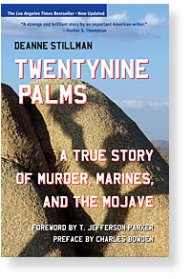
twentynine palms coverDeanne Stillman is the author of four books, including Mustang: The Saga of the Wild Horse in the American West, Desert Reckoning: A Town Sheriff, a Mojave Hermit, and the Biggest Manhunt in Modern California History, and Twentynine Palms: A True Story of Murder, Marines, and the Mojave. In 2013, Inlandia’s online literary journal published “The Lost Children of the Inland Empire”, an excerpt from Desert Reckoning. She teaches in the UC Riverside-Palm Desert MFA Low Residency Creative Writing Program.


Cati Porter: Much of your subject matter is inspired by the west — old and new, including the Inland Empire. What brought you to this region?

Deanne Stillman: I grew up in Ohio and had been wanting to escape for as long as I can remember. My father used to read the Edgar Allan Poe poem, “Eldorado,” to me when I was little. I would vanish into it, and later started to read Mary Austen, Willa Cather, Native American myths; Tony Hillerman was a professor of mine at UNM – an early trail guide. Also, I grew up around horses; my mother was an “exercise boy” at the racetrack, and that fueled my wanderlust. I was writing as a little girl as well, and knew I wanted to continue. Everything came together when I got out of Dodge, and, well, came to Dodge.


CP: In 2013, a year after Desert Reckoning was published, Inlandia brought you out to present for us at the Riverside Public Library, and it happened the same week the Christopher Dorner manhunt took place. What was that like?

DS: Strangely, Desert Reckoning – about a manhunt – merged with the Dorner manhunt as it was unfolding. One of the characters in my book, Rande Linville, lives in Big Bear, and had spotted Dorner’s burning truck during the search. He alerted cops, putting them on Dorner’s tail. Weirdly, Rande was planning to come to my talk that night, but his neighborhood was locked down as I was speaking! Remember the sirens? That was cops chasing Dorner. Also, the cabin where Dorner was killed was owned by some people from the Antelope Valley, where my book takes place. In the end, Dorner went out in a blaze of glory, like Donald Kueck, the hermit I wrote about. He had probably seen the coverage; I wrote about it for Rolling Stone and the manhunt became the template for other law enforcement agencies.


CP: Former Inlandia Literary Laureate Gayle Brandeis says of your work, “One of the greatest gifts of this book is how Deanne Stillman is able to open our hearts to people we might otherwise judge or dismiss.” How is it that you are able to paint such a complex portrait of the people you write about?

DS: Certain stories call me; they are place-based, generally, with the desert as a character. I’m sympatico with the people who live there, due to my riches-to-rags childhood which took my family from the right side of the tracks to the wrong side in about 24 hours. Suddenly we were persona non grata as far as certain relatives were concerned. I learned about America’s dirty little secret, class, at a young age. There were castaways, and I had become one.


CP: This is the fifteenth anniversary of the publication of  Twentynine Palms: A True Story of Murder, Marines, and the Mojave, about two girls killed by a Marine in Twentynine Palms after the Gulf War. What drove you to write this particular book?

DS: I was hiking in Joshua Tree National Park and afterwards, I stopped at a bar for a drink. I heard people gossiping about two girls who had been “sliced up by a Marine.” I asked about them and was told that they were “just some trash in town.” That hit me hard and I knew I would tell their story.


CP: Twentynine Palms was an LA Times “best book of the year” and bestseller, and Hunter Thompson called it “A strange and brilliant story by an important American writer”.  It’s taught in many college literary nonfiction classes, yet remains controversial. Can you talk about that?

DS: The town depends on the Marines and tourism for income. In part, my book is about a Marine with a history of violence towards women, and the culture that aggravated his behavior. The murders of Mandi Scott and Rosalie Ortega happened on dollar-drink night, which was Marine payday, when violence spiked. Twentynine Palms, which I love by the way, is the portal into Joshua Tree National Park. Some town elders were concerned that my book would drive tourists away. But to this day, people tell me they have visited Twentynine Palms because they love the way I wrote about the desert.


CP: All of your work features heavy material — a mustang massacre, the killing of two girls, a hermit who digs his own grave and commits suicide by cop.   Does this affect your emotional well-being?

DS: Yes, it does. It’s one of the reasons my books take years to write. Sometimes I have to step away. Incidentally, people come to me with violent stories all of the time. I am generally not interested. There must be a way in for me, and most stories of crime are smaller than the sum of their parts. I simply cannot write those.


CP: Your book Mustang will soon be released on audio with an all-star cast: Anjelica Huston, Frances Fisher, John Densmore (the drummer in the Doors)…. What has the process been like, seeing your book move into an audio format, and, more importantly, did you get to meet Anjelica Huston?

DS: Well, the cast is an embarrassment of riches, and they sound great! Everyone is now involved in the wild horse campaign, and some were before Mustang came out, such as John Densmore. I met Anjelica Huston some time ago; she had optioned Twentynine Palms.


CP: You’re also an award-winning playwright and screenwriter, with credits going back to the 80s teen television show “Square Pegs” and a recent play, “Star Maps”, performed at the Ink Fest series at the Hudson Theatres in LA.   What other projects do you have on the horizon?

DS: My next book, with roots in Mustang, is Blood Brothers: The Strange Friendship Between Sitting Bull and Buffalo Bill, which I’m writing for Simon and Schuster.

INLANDIA LITERARY JOURNEYS: Remembering ‘A Room of Her Own’

o6x6km-b88706664z.120160509101238000gp7gdvvv.10The book was going to be an easy undertaking: two months to revise, update and reformat a work I published in 1995 about “A Room of Her Own,” essentially a bookstore within The Frugal Frigate, a Children’s Bookstore in Redlands.

Instead, my undertaking launched a new adventure.

In July 1987, I lived only a mile from The Frugal Frigate in the restored historic district of Redlands, when educator and businesswoman Katherine Thomerson opened its doors. Soon, Katherine enticed Ann Schmidt to assist her.

Nestled to the right of the front entrance, Katherine maintained a steady presence of four shelves of books by, about and for women. “The Women’s Corner,” as it became known, met a deep and growing need in the community.

By January 1991, a separate space was created within the store for books by, about and for women. It was called “A Room of Her Own.” Ann was the primary keeper of the room.

Within four years, it evolved into the largest collection of books by, for and about women north of San Diego, east of Los Angeles and south of the San Francisco Bay Area. It became a center of intellectual, literary and creative activity for women in the Inland Empire.

In early 1995, Katherine gave me permission to conduct an ethnographic, or descriptive, study on the evolution of “A Room of Her Own” as part of my doctoral work. I tracked its growth and activities from March 1991 to August 1995, and included a photo essay.

It became clear that the room was a magical place.

There were thousands of books, mostly single copies, in 49 topically defined sections. Ann introduced readers to more than 124 books in her column in the monthly newsletter. The Monthly Book Group devoured and discussed 51 books, and a Spiritual Journey Group provided women a safe space for dialogue.

Finally, numerous scholars and authors including Susan Straight, Laura Kalpakian, and Patricia McFall gave presentations for 56 events in the outstanding Speaker/Discussion Series, held monthly, on the stage of The Frugal Frigate, free to the public.

I was a reader for three celebrations in the series, and my one-woman play, “Mother of the Mystic Garden: The Life and Times of Hildegard von Bingen,” debuted at one those events. In 1996, I also organized and presented “A Celebration of Sacred Songstorysound.”

In 1995, when Larry Burgess, then the director of the A.K. Smiley Public Library in Redlands, requested a copy of my study for inclusion in the library’s Local History Archives, I had only a partial understanding of how appropriate that decision was.

Ten years later, after 16 years of service, The Frugal Frigate, housing “A Room of Her Own” within, was sold. The 2,200-square-foot “A Room of Her Own” was dismantled.

In 2009, The Frugal Frigate sold again. The current owner, Gay Kolodzik, purchased the store in 2010.

Last spring, I decided to republish the study as a book accessible to a much larger audience. The story of “A Room of her Own” chronicles a unique, vital piece of women’s history in Redlands and California, on many fronts. It provided an exciting, vibrant literary scene, was a woman-owned business, supported the visual arts, scholarship, debate, education, self-discovery and community, to name a few.

I contacted Katherine Thomerson and Ann Schmidt, re-interviewed them, and received their blessing to revive the study. Ann was invaluable providing both archival and updated information. Amazingly, I learned, the Book Group has been meeting continuously since April 1991.

As word about the project spread, people voiced interest in contributing to it. A chapter on recollections was birthed.

I put forth queries, conducted interviews, and contributors generously submitted reflections. Artist Christine Curry Coates writes of how the murals Katherine commissioned to grace “A Room of Her Own,” launched her successful career as an artist. Laura Kalpakian, Gayle Brandeis and many others penned their memories.

It has been a time of community: of rekindling and reconnecting, laughter and tears.

The anticipated two months to publication has turned into a year of unfolding processes now nearing completion. I’m grateful for, and humbled by, the results. The project took on its own energy, once again sweeping me away on a frigate to A Room of Her Own, providing gifts far beyond what I ever imagined.


Inland author Joan Koerper has published everything from poetry to scholarly research. She earned her Ph.D. in Writing and Consciousness at the California Institute of Integral Studies, San Francisco.

INLANDIA LITERARY JOURNEYS: Neglected titles have volume of life

o6x6fj-b88698409z.120160509100902000gn0g7dlp.10Gardening and reading are often pictured together as delights practiced into the afterlife, probably because people can’t imagine ever giving them up.

While everyone knows that gardeners have to weed their plots to get rid of plants that would choke out the beauty of the whole, book lovers rarely consider that good libraries must be weeded as well if they hope to avoid the fate of becoming frozen in time – dusty, unused and overseen by a Miss Havisham of a librarian.

The removal of books – seen as artifacts – has often caused much drama for small local and school libraries that attempt to stay current.

As a school librarian working on a campus that several years ago celebrated its centennial, I am one of a long series of teacher librarians who have never had the time to properly cull the collection. So much remains on the shelves that should have left the building decades ago; these books become time capsules, and the weeding is a romp through pop history and culture.

It’s difficult not to have deep affection for outdated books in the same way one might for a ride that is torn out of Disneyland because its time has passed.

As a form of amusement, the book itself, the information it contains, or its author, might have been a part of our childhood or, in a library as old as mine, our parents’ or grandparents’ childhoods.

I recently promised myself to remove the library’s never-used books from the shelves. Some were easy to pull, such as the science books that stated that one day people would land on the moon.

With others, I fought an undercurrent of affection, the source of which was puzzling. The checkout history of “A First Electrical Book for Boys,” published in 1936, was lost; however, the book was never added to the circulation system when it was automated in the late 1980s.

I imagine innocent, inquisitive kids pouring over it. I like to picture smart, sneaky girls taking the book home with the compliance of their librarian.

“The Story of X-ray” from General Electric is a pamphlet that appears to have been printed in 1949 and was checked out nine times from 1951 to 1959. It pictures a technician without any protective garments taking X-rays in a hospital room with a mobile unit. X-ray technology itself is described as something of a creepy Big Brother: “There is practically no region of the body that is not subject to its searching eye.”

Shelved nearby, “The Walt Disney Story of Our Friend the Atom,” published in 1956 and acquired in 1958, enjoyed numerous checkouts ending in 1981. Despite being fabulously dated, it does appear to be a friendly book, with its full-color illustrations and cartoon images.

I move to find books that are either “head scratchers“ or “heartbreakers.”

“Cheese Varieties and Descriptions” from the U.S. Department of Agriculture (Agricultural handbook No. 54), first issued in 1953 and costing $1.75, was never checked out. Even back in the day, it seems teens were focused on something other than their future wine-and-cheese parties.

More curious yet is “How to Know the Eastern Land Snails: Pictured-keys for determining the land snails of the United States occurring east of the Rocky Mountain Divide.” Published in 1962 and acquired in 1967, it was checked out once, in 1970. That’s once more than I would have put money on.

The “heartbreakers” include “National Geographic’s Song and Garden Birds of North America.” This volume is beyond beautiful, its heavy glossy sheets thick with full-color images of every imaginable bird. It’s an early interactive book, complete with a booklet of bird songs on several flimsy 45-rpm vinyl records.

INLANDIA LITERARY JOURNEYS: Persuasion and pitfalls in political poems

o5n5zl-b88689179z.120160414135006000gt9g06if.10This is the year it could happen. Maybe you’re stuck in a stop-and-go rubberneck on the 91 freeway, the radio a dull drone through your morning migraine as the partisan station of your choice recaps the political news of the day.

Maybe it’s already happened. Maybe you’ve already begun thinking of words that rhyme with candidate names.

Wherever it happens, you might have the sudden urge to write a political poem sometime during the next eight months. To help you get ready, I’ve prepared this simple guide to help you handle the situation with aplomb.

First of all: Don’t panic. Pull to the side of the road somewhere safe, or wait for the nearest exit, then find an empty parking lot or an exceptionally long drive-through line. Poems sometimes write themselves, but they can’t write themselves while you’re driving. Only poem in park.

Don’t feel guilty. A poem is just a special way to talk about special things. We all have an innate desire to say the un-sayable, to articulate all that lies just beyond the reach of articulation. Poetry can happen to anyone, anywhere, so remember: It’s not your fault.

Find a recording device. Use your smartphone, if you have one, to record your poem as a voice memo, text it to a friend, email it to yourself, or tap it out using a standard writing application.

If not, many of the world’s greatest poems have been written on ancient, crusty glovebox napkins. It’s true. If all else fails, there’s still memorization, a pneumonic device, which historically has been the point of poetry more often than not. Whatever tool you use, just don’t lose it.

Now that you have your poem saved, the real trouble begins. Sure, you’ve written something “felt in the blood and felt along the heart,” as Wordsworth put it, but what next? Does your political poem have any cultural value? Should you share it with close friends, or perhaps even the public?

On this question, poets themselves have long been split. In “A Defense of Poetry,” Percy Shelley famously wrote that “poets are the unacknowledged legislators of the world,” and others have been trying to pat themselves on the back equally firmly ever since.

William Carlos Williams says, “It is difficult to get the news from poems yet men die miserably every day for lack of what is found there.” Your political poem could be a matter of life and death! More recently, Meena Alexander writes that, “We have poetry/ So we do not die of history,” a statement I particularly love.

Not everyone agrees, though. In a 1965 lecture to students at Berkeley, Jack Spicer said, “I don’t know of any political poems which have worked,” and suggested instead of writing poems that they write letters to their congressmen. Both would be equally effective, he reasoned.

I once asked National Book Award winner Troy Jollimore why he finds political poems difficult to write, and he worried about preaching to the converted: “The people who know those are good values are already on my side; the people that don’t think they’re good values aren’t going to be convinced by my siding up with good values.”

He has a point, too. A poem isn’t an argument. A poem’s purpose isn’t to persuade — persuasion is for op-eds and campaign ads.

So keeping that in mind, re-read your political poem. Is it cheerleading, or is it trail-blazing? Does it reach deeper into the abyss to haul up some new creature?

Just last week, an Orange County poet named David Miller wrote in a political poem, an elegy for the personified American Dream: “I ran when I heard you crying/ like a phone, no one told me how alone you are.” Now that’s what Shelley meant when he said that poetry “purges from our inward sight the film of familiarity which obscures from us the wonder of our being.”

Be honest, does your political poem really purge the film of familiarity, or is it just more mosquito guts on the windshield? If it’s the former, then by all means share it widely! This is the year for purging.


Wrightwood author Timothy Green is editor of Rattle magazine

INLANDIA LITERARY JOURNEYS: Writing helped family pursue justice

o5hej0-b88676034z.120160411110922000gh0fr950.10A mother’s worst nightmare became my reality. The midnight phone call from a sheriff’s deputy waking me with horrible news: My son, Mark, had been “in a collision and he did not survive.”

The rest is a huge blur. My adult son was the victim of a hit-and-run crime, and he was unable to defend himself. His voice was silenced. It became our family responsibility to ensure that Mark’s voice would be heard.

During the criminal trial, we were offered the opportunity to address the judge by writing a victim impact statement. It allowed us to tell the court about the effects, the impacts of Mark’s death and the damage the offender had caused.

We read our statements out loud during the sentencing hearing.

I held a large photo of Mark to put a real face on a judicial case number. Like Joan Didion in “The Year of Magical Thinking,” I wanted to scream, but I remained calm. Mark’s voice resonated through me, through his father, his son, his brother and his aunt. We spoke for him.

Victims are seldom called to testify in court, and if they do testify, they must respond to narrow, specific questions.

But the California Constitution allows victims to present written and oral statements. These statements are often the victims’ only opportunity to participate in the criminal justice process, or to confront the offenders who have harmed them.

These are testimonials about how a crime has affected them. They generally are included in the presentencing report presented to the judge and are allowed during the sentencing process.

When a victim is deceased, as in our Mark’s case, the relatives have the right to be heard. A judge may use information from these statements to help determine an offender’s sentence.

I welcomed the opportunity to articulate to the judge how my son’s death was a horrible loss to our family. And I was able to list prior offenses committed by the offender that had been stricken by the judge during a pretrial hearing.

I also helped Mark’s 12-year old son, Paul, write a statement about how the loss of his father affected him. His Uncle Leonard read Paul’s statement at the trial.

There are benefits to writing an effective statement. Fairness and justice for your loved one is the main goal. It could be your best shot at persuading the judge. Like writing in a journal, the reflection process and the act of writing down your thoughts about the crime’s impacts help with emotional healing.

Indeed, it improved my satisfaction with the criminal justice system, especially when the jury ruled in favor of the people of California, as they did in our case.

The Riverside Main Library has stacks of volumes in the 800-section that may help those unsure of how to write a statement. For example, Beth Kephart’s “Handling the Truth: On the Writing of Memoir” and Brandon Royal’s “The Little Red Writing Book” are full of advice and recommendations.

When your case goes to trial, be prepared for the bad memories to be relived all over again. Attend all court hearings, especially the trial. It demonstrates that the victim is loved and supported. Keep notes of the proceedings and visit the Superior Court website frequently to review the minutes and other documents regarding the case.


Inlandia Institute president Frances J. Vasquez writes about the importance of victim statements

INLANDIA LITERARY JOURNEYS: Bountiful bloom despite drought

By Ruth Nolan

o4ynt0-b88675956z.120160401081556000gjhfnkvc.10Stories of the rare “superbloom” in Death Valley National Park, exploding colorfully across one of the world’s hottest, driest and lowest regions, have traveled far and wide as late winter transitioned into early spring this year.

Inland residents have the special privilege of living within easy driving distance of Death Valley, and legend has it that this year’s bloom is especially beautiful, following a historic monsoon rainfall in the northern Mojave Desert in October.

Many well-known desert personalities and authors have eloquently publicized the aesthetic influence of desert wildflowers.

The late Coachella Valley artist John Hilton penned a humorous and memorable essay for the old Desert Rat newsletter (circa 1930s-1950s) about the intoxicating power of seeing and walking through the swaths of deep pink sand verbena that carpet fields and sand dunes throughout the Coachella Valley in the spring, their abundance depending on rainfall levels in winter months. In fact, many of Hilton’s most treasured Coachella Valley landscape paintings have sprinkles of sand verbena in them.

Yes, desert wildflowers are beautiful – and especially given that they don’t bloom abundantly every season, and that when they do, their stunning appearance is so short-lived. Soon, the lengthening days of spring and the early summer onset in Death Valley, where temperatures soar high above 100 degrees day after day for months, will burn the yellow and purple wildflowers away and they will be just a faint memory on the raw, scorched landscape. Beyond appreciating the sensory and fleeting beauty of the flowers, which in itself is quite a thing to behold, why should we care about the deeper importance of desert wildflowers?

Native Americans living in our deserts have long relied on plants as critical components of survival, especially as food. Many of the wildflowers you’ll see blooming, not only in Death Valley, but in Joshua Tree National Park, in the Coachella Valley and in the higher-elevation chaparral transition zones of areas such as the Santa Rosa Mountains, have long been important food sources for the Cahuilla, Serrano, Chemehuevi, Timbisha Shoshone and other desert tribes.

I recently observed part of an ongoing yucca harvest workshop involving native desert participants at the Dorothy Ramon Learning Center in Banning. The day I visited, mothers, daughters and other women were busy preparing beautiful, cream-colored yucca blossoms – tinted with green and magenta hues – for a delicious yucca blossom salad, which resembles macaroni shell pasta salad, but tastes much richer and a bit sweeter. This is just one of many ways yucca flowers have been used for centuries in traditional foods, while many everyday items such as sandals and soap have been made from other parts of the plant.

Most people associate the ominous presence of barrel cactus with danger: The sharp, curved barbs can indeed inflict a lot of damage to human skin and body parts. However, the barrel cactus, which grows throughout California’s deserts, produces abundant blossoms – both yellow and bright pink – that have been used by desert Indian people as a food source, like yucca blossoms.

In her memoir, the late Cahuilla historian and culture bearer Katherine Siva Sauvel wrote of her childhood memories of harvesting barrel cactus flowers, a nutritious and sweet snack, from Devil’s Garden, an area near Palm Springs.

Desert wildflowers matter. They mattered in the survival of our desert’s Indian people for centuries, and they matter now.

They are a measure of adequate rainfall that’s crucial for replenishing desert aquifers for human consumption and for the rare riparian areas that provide drinking water for desert animals and sustenance for the many plants that provide life in a land that can be unforgivingly harsh.

This year’s superbloom in Death Valley and the rest of our deserts has given those of us in the Inland region a bit of an uplift in a long, nervous time of ongoing severe drought, which has been only minimally eased this winter by an El Niño that never really showed up with the downpours we had expected.

With the flourishing of wildflowers this spring, we’re blessed with an extra dose of natural beauty that lifts the human spirit and gives us the hope of replenishment, both natural and aesthetic, all from one of the world’s most unlikely places, which we are fortunate to call part of our desert backyard.

David Stone

Love Lines for Your Valentine

Still need to write your Valentine? Use lines from a local poet.

Someone seeking clarification about another’s romantic intent and who enjoys the use of lowercase letters like e. e. cummings might appreciate a line from Cindy Rinne’s “Another Park Poem.” Inspired by a walk in Riverside’s Fairmont Park, Rinne wrote, “did you try to carve the bark/ leave a heart…” Rinne lives in Redlands. Her next work is titled “Quiet Lantern.”

Courageous individuals who are willing to be vulnerable might use lines from Cati Porter’s poem “Clearly.” “Look at me/ and tell me that you want me, that you want to heart/ the distance and that you cannot in the object see/ a flaw, and though I am (flawed) I am for you, and/ there is a small tight thought that is wound in me,/ that knowing that you love, a lightning, a lightning/ on the inside: so that you see; so that you know.” Porter lives in Riverside. Her latest book “My Skies of Small Horses” comes out this month.

Seasoned lovers may like to use lines from “Litany” from Claremont poet Lucia Galloway’s latest chapbook “The Garlic Peelers:” “O love, what is your wish?/ We’ve half again as much to say as we have said./ Set down the goblet, and the carmine wine/ sheets down its sides to pool in the bowl./ Let’s drink our words instead of hoarding them.”

Sweethearts who remind you of characters from the The Big Bang Theory should appreciate lines from Marsha Schuh’s “You and Me in Binary.” Appropriately published in the computer textbook Schuh co-wrote with Stanford Rowe, Schuh imagines a world based on four, considers the dominance of the decimal in our world and closes her poem with pondering the numerical effects of becoming a couple: “Then we unlearn it all /learn to speak binary,/ a better way,/ two as opposed to eight or ten,/ the most significant bit,/ the least significant bit/ one-two, on-off, you-we,/ binary.” Schuh resides in Ontario.

Lovers in a more ambiguous relationship may resonate with lines from the Palm Springs poet and writer Ruth Nolan. In her forthcoming book, “Ruby Mountain,” she writes, “shouldn’t I pretend you did it for love/ shouldn’t I believe it was a mistake/ shouldn’t I wonder why not/ shouldn’t I wonder why. . . .”

Those pained may appreciate the words of the title persona in Nikia Chaney’s “Sis Fuss.” The poem “Syllogizing Sis Fuss” closes: “we all hurt. And if we all/ hurt then we all hurt/ each other and the next.” Chaney lives in Rialto.

Jennifer and Chad Sweeney from Redlands are a couple, who are both accomplished poets. Jennifer provides profundity and striking imagery in her book “Salt Memory.” She writes, “As water poured into the heart flows out the palms, so does love return, as thirst, as satiation—the shape the lost ocean has carved onto the salt brick desert.”

With characteristic quirky humor in his book “White Martini for the Apocalypse,” Chad writes, “It was love./ She taught me to drive her bulldozer./ I taught her to forge my signature!”

In earthier lines from his poem “Effects,” first published in Caliban, Chad writes, “The best sex in the world happens during conjugal visits. I’ve gotten myself into prison twice, just to have it. That’s why I’m calling. Happy Valentine’s Day!” Chad Sweeney teaches creative writing at Cal State San Bernardino.

The longing and transformative power of love comes through in the closing lines of Judy Kronenfeld’s “Listen” from her forthcoming collection, “Bird Flying Through the Banquet,” 
“Let your eyes rest/ on my face. Arrest me/ in turn. I will burst/ from the seed/ of myself.” Kronenfeld is professor emerita from UCR.

Ontario poet Tim Hatch gives words to the desire to comfort one’s dearest when he or she is gone: “Scatter my memory where my memories are sweetest. Gulls cry, salt breeze carries me away. When you’re there you can breathe deep, take me inside and remember.”


For a wider array of classic poems to use for Valentine’s Day, search the Poetry Foundation’s website for “Poems for Valentines” or the poets.org site for “love poems.”

Frances J. Vasquez

Remembering Anne Frank

For many of us Gentiles, our introduction to the horrors of the Holocaust often begins with reading The Diary of a Young Girl. Anne’s parents presented her with a red-checked diary for her thirteenth birthday on June 12, 1942. Anne was enjoying a relatively normal life for a Jewish girl in occupied Amsterdam. She lived with her mother, father, and sister, and attended school like others her age. But less than a month later, their lives changed forever. Anne and her family went into hiding in the “secret annex” of her father’s warehouse and office building. During the two-years of their oppressive hiding period, eight people stayed indoors twenty-four hours a day. The Frank family’s love of literature helped sustain them until they were arrested by the Nazis and deported to concentration camps.

World War II was raging. Nazi Germany had invaded the Netherlands. Life was dangerous for Jews. This is the context in which Anne wrote. She became a prolific writer while in hiding. The pen was her best friend. The teenager aspired to be a journalist and to become a famous writer after the war. She documented her two years in hiding in her world famous diary and wrote, “one day this terrible war will be over. The time will come when we’ll be people again and not just Jews!” Anne also expressed herself in short stories, fables, and other creative endeavors. Writing helped Anne cope with the emotional and physical rigors of living in confinement. She channeled her fears and tension into written descriptions of daily events with wit, humor, compassion, and candor.

I purchased a copy of Anne Frank’s Tales from the Secret Annex during a visit to the Anne Frank House in Amsterdam. This edition was first published in London in 2010 by Halban Publishers, Ltd. The book includes some of Anne’s personal reminiscences, daydreams, and essays. It also features her fanciful fables and short stories. One of the essays, “Do You Remember?” describes Anne’s wistful memories of school days at the Jewish Lyceum. She writes about “many a delightful hour talking about school, teachers, adventures, and boys. Back when our lives were still normal, everything was so wonderful.” Anne remained hopeful of returning to school as she recounted other memories prefaced by “Do you remember?”

Indeed, in the best interests of human dignity, we remember Anne and her writing, and the horrific genocide that resulted in the death of millions of European Jews by the Nazi regime during the Holocaust of World War II. This Wednesday, January 27 is International Holocaust Remembrance Day. The Resolution, designated by the United Nations General Assembly on November 1, 2005 declares that member nations “honor the memory of Holocaust victims, and encourages the development of educational programs about Holocaust history to help prevent future acts of genocide. It rejects any denial of the Holocaust as an event and condemns all manifestations of religious intolerance, incitement, harassment or violence against persons or communities based on ethnic origin or religious belief.”

Why January 27? On this date in 1945 the largest Nazi concentration camp, Auschwitz-Birkenau, was liberated. Lamentably, only 21 days earlier, Anne’s mother, Edith Frank-Hollander, perished at Auschwitz. Anne and her sister, Margot Frank, died in the Bergensen-Belsen Nazi concentration camp less than two months later in March 1945. Their father, Otto Frank, survived Auschwitz and was the only “secret annex” inhabitant to outlive the hell of war to carry on his work with vision and tenacity.

After reading and publishing his beloved daughter’s diary, Otto Frank redirected his heartache and sorrow to tell her story. He dedicated the rest of his long life to work on combating discrimination and prejudice: human dignity and rights for all people regardless of race, ethnicity, and religion. Since the first publication of Anne’s diary in 1947, over 40 million copies have been published in 70 languages. In 1960, the hiding place was converted into a museum. It is one of the world’s most visited museums. Otto Frank posited, “to build a future you have to know the past.” When I visited the Anne Frank House in June 2015, the long lines of people coiled for blocks. I didn’t mind. A visit to the Frank’s secret annex was a significant pilgrimage.

Anne was an extraordinary girl whose maturity and wisdom is evident in her writing. In Tales from the Secret Annex her fables and short stories exhibit creative optimism and hope as she transports to other realms. “The Wise Old Gnome,” “The Guardian Angel,” and “Blurry the Explorer” are a few of numerous examples of Anne’s ability to see good prevail over evil and sorrow. The enduring interest and inspiration of Anne Frank’s writing reflect the continued relevance of the topics she expressed in her diary. While there is no happy ending to Anne’s life, her writing is her enduring legacy. The words of one girl made an indelible difference. Anne fulfilled her dream to become a famous author. Brava, Anne Frank! Her memory continues to inspire awe in new generations of readers.


Frances J. Vasquez is president of the Inlandia Institute board and a member of Inlandia’s Riverside writing workshop.

For more literary journeys, visit the Inlandia Literary Journeys Blog or the Inlandia Institute.