Sonambulant Funambulist: Countenance by Maureen Alsop

Lisa Kiernan cordially invited my response to the following questions:

What are you working on?
I’m presently anticipating the release of my third full poetry collection, Later, Knives & Trees (Negative Capability Press). I’ve also been engaged in a response to poems through image.
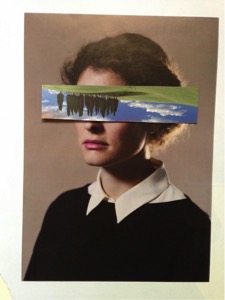
Over the summer I started two projects: 30×30, in which I’ve been creating 30 second videos overlaying audio excerpts from Later, Knives & Trees. Also a bodily, organic response to collage: 27/24 which may extend itself. The premise of carrying a collage upon the body for 24 hours. What have you learned from the message, the unattached self before the self. Strange illusion. Mostly. Seeking the ‘cosmic countenance’ inside the countenance, asking or responding to the secreted self, “what do you want to do next?”

3

4

5


How does your work differ from others of its genre?

I’m not sure it does. Maybe it shouldn’t. It just is. I’m human, like a snowflake.

21


Why do you write what you do?

See Tab: The Journal of Poetry & Poetics: space before text.

From a lecture I gave on Peristaltic Googlism and the Metaphysics of Ephemera and a quote worth repeating:

“Once you’ve heard a Maytag wafuuoom-per, wafuuoom-per throwing its never erring voice across the back yard, you’ll understand a knack for making songs. You’ll understand what Hank Williams’ rhythm section was doing at the laundry mat in Texarkana all night, June 1948; the night Hank knocked up Windy Beauchamp after she auditioned as a dobro player. Birds speak dialects, as people do. Dolphins use sound as a weapon. Crickets won’t answer recordings of their own voices. Even a small fish like an anchovy can hemorrhage, hearing nothing, a silence finally loosing substance.” — Walter Lab

Whether it’s the Maytag’s wafuuoom-per or a hemorrhaging silence, disparate elements endlessly congeal to form the delicate architecture of a poem. Why ask why? Ask, why not.

How does your writing process work? 
I’m not much of a cook. I seem to think there is only one heat level: HIGH. I write like I cook. Sporadically, intensely, quickly. I try to enjoy it. Always wish I did it more. I’m probably best around a fire pit. I’m comfortable with both the raw and refined.


For additional responses from incredible thinkers I’ve asked Sarah Maclay, Nikia ChaneyElena Karina ByrneSparky Campanella, Nic Sebastian, Lauren K. AlleyneCati Porter, Christina Cook, Marcia LeBeau, Farrah Field, Jared WhiteBethany Ides, Linnea Ogden, Cynthia Arrieu-KingCindy Rinne, Prageeta Sharma, Anna Leahy and others.

Alexa Mergen

Autobiography


In plexiglass pillboxes I collect samples of wind, align them
on spice shelves above the kitchen sink, a measure of my life.
The story goes I emerged in an Iowa blizzard. Snap
a chip of deep night, label: December 1967. DC in ’73. Into this box
set wet wind—summer thundershower. Augusts in Nevada. Dry
bluster off sand mark ’76 ’77, ’78 through ’84. I’m a teenager at Rehobeth, up
at dawn after bonfires and beer. Into this box a handful of Atlantic salt air
misted by porpoise exhalation. 1985. Berkeley fog bubbles the specimen label.
Wedding day, August 19, 1992. Forest fires scorch Volcano. A sooty sample.
Two years later we sail San Francisco Bay in a gale, scoop an armful of pulsing Pacific wind off the jib for my collection. Let’s include Kay’s final breath in ’97—it fell out as a sputter— and the bilious tempest of my brother who hollers stay away!
Label also whispered breeze of reconciliation.
Add delight’s gusts, desire’s zephyr, siroccos of ceaseless seeking. Doldrums. Then,
tickles of air on undersides of poppy petals. This a log of landscape felt as it touches other things. Everything a breath. All atmosphere cooled and warmed in layers.


The first month Alexa Mergen lived in Yucca Valley she learned how to respect rattlesnakes and scorpions and how to recognize a dust devil. She grew up in Washington, DC, making visits to family in the Great Basin and Mojave. She now lives in Sacramento. In addition to poetry, Alexa writes fiction and essays. Her favorite places are windy ones–mountaintops, deserts, and seashores.

Michelle Gonzalez

Workshop Feature: Inlandia Creative Writing Workshop – Riverside

Workshop Leader: Ruth Nolan

__

215/60/91   

Getting on the 215 to San Bernardino meant
we were going to grandma’s house.
Passing the 5th street exit,
then getting off at Baseline
meant I would be
making fresh flour tortillas on Saturday
and walking to St. Anthony’s on Sunday.

Going on the 60 meant
a trip to the drive-in movies
right by Rubidoux mountain
where you can see the truckers pass
on the freeway as they honk their horns.
I climb into bed at 1 am after
trying to stay up for two movies.

The 91 freeway to Riverside meant
possibly going to the mall,
getting new shoes for school
or maybe even a long trip
to the sandy beach.

But at the end of the day,
I was always glad to be home
where I have my new daybed
and flower bed set
that matches my sister’s.

Midnight Drives   

On the third of our many dates,
we drove down the 60 freeway
around the midnight hour
to see the glimmering meteors.
We talked about how
beautiful the sky would look
once we got to the badlands,
small, but still beautiful.
I imagined it would look like
a brighter version of the moon,
glowing in the darkness
all alone.

We passed the exits with the stores
and other signs of life,
until we reached our destination.
The headlights lead the way
to the dark hidden spot.

We got out of the car and
sat on his dusty hood.
Looking up, all we saw were
the shadows of clouds
covering the dark sky.
There were no meteors to be seen,
but somehow, that was fine with us.
We decided to stay and talk awhile.
He asked, “Have you ever made a wish,
on a shooting star?”
I lie and say, “No.”
It’s too early to tell
all my secrets.


Michelle Gonzalez is a longtime member of Inlandia’s Creative Writing Workshop in Riverside. She earned her BA in English from the University of California, Riverside. She also received her teaching credential from University of Phoenix and MFA in Creative Writing from National University. For the past 29 years she has lived in Riverside and has no plans on leaving the Inland Empire. Her poems have been published in National University’s literary magazine and other local magazines such as Slouching Towards Mt. Rubidoux  Manor and 2011 Writing from Inlandia: Work of the Inlandia Creative Writing Workshops. Recently she has published her book of poems, Morning in the House by the Field.

Alexa Mergen

Child of the Wandering Sea

Leaving thine outgrown shell by life’s unresting sea!

                        –Oliver Wendell Holmes, The Chambered Nautilus


At the corner of Alta and Sunflower street signs hum
like conch shells in sagey wind. The last water receded
an eon ago: runs deep beneath your feet if at all.

The sound sings your first trip west, whipping over desert
in a silver bus. Shells along shelves in shops at Fisherman’s Wharf.
You held pink rims to your ear understanding then the nautilus

your teacher silenced without definition. Didn’t he know
a poem’s tones seep through pages when pressure builds?
You returned after seafaring to the desert wind,

wind like the ocean’s. The shacks are
sinking beam by board into brown sand:
a flag pole clanks in a wide lot:
air pulls forth what was forgotten.


Alexa Mergen lived for two years in the high desert town of Yucca Valley where she walked dirt roads, admired the Milky Way, and listened to wind. She grew up in Washington, DC, making frequent visits to family in Nevada and Utah. Alexa studied Literature and Writing at George Washington University, UC Berkeley, and UC Irvine. Her poems and essays appear in numerous publications. She currently lives in Sacramento where she leads workshops in poetry and memorizing poems, and works as a freelance editor.

Cynthia Anderson

The I-10

Born in 1897, a San Bernardino native son,
my grandfather lived to be 100. Late in life,
when we would take him out for a drive,
he would point to some shopping mall
off the I-10 and say, We used to hunt
rabbits there.

When he retired from title insurance,
he had a farm in Cherry Valley,
fruit trees and eggs. Then, in Yucaipa,
he looked after my grandmother
who hung on 22 years after a crippling
stroke, with a will to live she learned
as an only child in Randsburg,
where her father worked for the mines.

Time and again, I would drive down the coast,
pick up the I-10 in Santa Monica,
take it straight through the polluted heart
of L.A. to the hinterlands, find my way
to the Yucaipa house by memory,
never using a map, never thinking
about how much the freeway
had changed the land in its short life.

My grandfather spent his last days
in a convalescent hospital in Riverside.
He remembered when the palm trees
along on Magnolia Drive were planted,
recalled Sunday drives before the first
world war. He and my grandmother are buried
in Desert Lawn, hardly a resting place,
the I-10 a noisy witness to the end
of their lives and the world they knew.


Cynthia Anderson lives in the Mojave Desert near Joshua Tree National Park. Her award-winning poems have appeared in journals such as Askew, Dark Matter, Apercus Quarterly, Whale Road, Knot Magazine, and Origami Poems Project. She is the author of five collections—”In the Mojave,” “Desert Dweller,” “Mythic Rockscapes,” and “Shared Visions I” and “Shared Visions II.” She frequently collaborates with her husband, photographer Bill Dahl. Cynthia co-edited the anthology A Bird Black As the Sun: California Poets on Crows & Ravens.

E.J. Jones

Cheating


          It was early Saturday and my son, Wesley was already at the park with his friends.  Like everyone around Blythe, he started his October mornings when it was still cool, before the desert heat set in.  Tanya, my wife, was in her garden doing the same.  The house was all mine.  I picked up the paper grinning about having the morning to myself.  No honey-do’s, just me and twenty-four hours till the next football game.

          Yesterday’s mail was on the counter next to the coffee machine.  Under a refinancing mortgage flyer, there was a letter with Georgia on the return address.  I didn’t dare touch it, but nudged the flyer away with my coffee cup.  I hoped the letter was either a mistake or a bad joke because up until then I was having a good day.

It’s weird how things jump in my head.  A bad pass interference call will make me remember I left a fountain pen in my favorite shirt.  My home address written in my mother’s hand reminded me I’d hid a bottle of good bourbon in the garage two years ago.  It was a gift from my boss, and I could give a million reasons why I’d kept it, but the truth was that Ten High was good liquor.  I was taught to never throw things like that away.

Staring at the envelope made me sweat, so I dumped my coffee and poured me some of Tanya’s grapefruit juice.  I didn’t want to touch the letter, but poked at it with a spatula like it was something that might bite.  After flipping it like a pancake, I saw red lipstick where the ‘V’ sealed it shut.  I knew those lips; I’d wiped the same imprint from my forehead and cheek a hundred times as a kid.  Momma was big on kisses before school.

The juice didn’t help my sweat or the cotton in my mouth, and I figured I better do something before Tanya came in asking questions.  It was dumb, I know, but I went to get the bourbon.  Tanya nodded as I walked by.  I hadn’t had a drink without her for more than fifteen years.

The bottle was in my tool box, somewhere Wes would never be without me, and somewhere Tanya’d only be if I died.  It was a bonus from winning the company football pool, close to six-hundred dollars that went mostly to a BMX bike and pearl earrings.  I bought socks and underwear for myself because you can never really have enough.  My regional manager, Keith had tossed a lump of rubber-banded twenties on my desk and put the bourbon down next to the money.  Enjoy it, you lucky bastard was written on a post-it stuck to the bottle.  Keith was a good guy, but he was the dummy that bet Seattle every year.  Him giving me the bottle made me realize no one at work really knew me.  I thought about giving it away, but only real friends deserve quality and Tanya was my best friend.

I sat on my tool box and rested the bottle horizontal across my knee, whacking it on the ass a few times.  I’d never liked the smell of liquor and took a swig without putting it to my nose.  The heat in my stomach gave me courage I didn’t really have, and I went back for the letter.

Tanya barely looked up at me on my way back inside, so I hid behind a bush to watch her.  Turning over top soil and clearing weeds was what she loved most next to me.  She dug into the ground hard, stabbing into it like she’d been wronged.  And then real gentle she spread fresh soil around her marigolds like she was putting on a band aid.

Her braided hair was away from her face and wrapped inside my old UC Riverside cap.  We always joked that her two years there plus my two made us an educated couple.  Standing there with the bottle in my hand was stupid because if Tanya saw me peeking around the bush at her, she’d have known something was wrong, even at a glance.  I loved watching her though, especially if she didn’t know I was looking.  Whenever she felt she was alone, her beauty was effortless, coincidental.  Hell, maybe even accidental.  I was never smooth with women, but when I saw her at The Getaway, the campus bar, nursing a Jack and coke with that all alone look, I had to talk to her.  We both had a few more drinks, and I asked if we could do it again sometime.  She leaned towards me and put her hand over mine, her smooth dark skin covering my pale knuckles.  “I don’t think that would be a very good idea.”  I couldn’t accept her saying no; I was hooked.  Tanya claims she didn’t know it, but I’m sure she did.

It was hard a first:  black guys looked at her like, ‘What the hell are you doing?’  White girls glaring at me asking, “Why would you even do that?”  Not Georgia bad, but it did start fights.  We’d worked through a lot.

Seeing Tanya in her garden made me want to get on my knees beside her, bury the letter unopened, spray it with weed killer and wait to see if something beautiful would grow.  If I’d had the courage to pick up the letter earlier, I might have done just that.  But she’d smell the bourbon now.  Her nose was a good as mine.  There was a fight coming, but I didn’t want to have it just then.

Our house was a modest three bedroom, most in Blythe are.  Wes’ room is closest to the front door, but he’d never seen me take a drink and I aimed for him to never have to.  The master bedroom was at the end of the hall, but it seemed a long ways off.  The office was in between and the coolest anyway.  His and her desks were pushed up against the walls.  I sat the bottle on the floor next to mine in case I decided to try and hide it if Tanya came in.  When the silver blade slit the crease in the envelope, I saw sweat beads racing down my temple in the reflection.

The letter was only one page.  I turned it over and the back was white, blank.  If there were words that could make up for sixteen years of silence, I knew damn well they couldn’t fit on a single page.  The very first word was, Son, and it was the worst word to start with.  I dropped the letter in my lap and took a good swig.

My parents never called me, Son.  Hey You, maybe.  Boy, I heard several times, but not a word that tied us together as family.  Not since I showed up with Tanya and a wedding ring on my finger.

The third line said my father was alive, but doctors couldn’t say for how long.  I don’t understand why, but I sympathized, a lot.  I knew he was afraid to die.  And neither one of us faced our fears very well.

There was a big ink splotch in the L of We Love You.  The pen bled ink while they wondered whether love was the right word.  Momma wrote it, but I knew my father was looking over her shoulder, dictating.  She’d stopped, and then looked at him for approval.  Who knows how long before he answered.  I took my time, too, had a few drinks before reading on.

If you want to see him, it will have to be soon.  The words were supposed to be an invitation. Leaving the front door open was as far as he was willing to go.  I wasn’t sure how far I’d go.  I put the letter and the bourbon in my lap.  Looking at them, I couldn’t tell which was worse.

*

          “Hun?”  Tanya’s voice was still outside, but close.  “You didn’t turn on the AC.”
One of the things I’d hated most about drinking heavy was that time slipped.  Heat had invaded the house, and I was sure it was almost afternoon, but it felt like only minutes had passed.  I hadn’t moved except to lift the bottle to my mouth. She was beating the dirt off her sneakers before coming inside, something neither one of us could get Wes to do regularly.  I didn’t run, but I wanted to.

“You in there, Babe?”

I took one more good swig and capped the bottle; not much could have made the situation better and nothing could have made it any worse.  Tanya stared at me from the doorway, her arms pressed against the arches like she was bracing for an earthquake.

“What happened?”

She was asking whether she should hug or kill me.  I blinked and she’d covered the ten feet from the doorway to my side.  She snatched the bottle when I didn’t answer.

“My fathers dying,” I said, pointing to the letter.  “Wants to see me.”

“We’ll send a card.”

Tanya had a way of closing herself off when things got bad.  It was how she coped with her father’s drinking.  Everything about her became rigid, stone.  Nothing could penetrate and hurt her then.  She’s a good cop because of it, but I swear I don’t know her when she gets like that.  She knew she was hurting me.

“I’m going.”

“Bye.”

There was no hesitation in her response, just a reaction, concrete bouncing back a rubber ball.  She walked out with the bottle, and I heard her pour the rest in the toilet, flushing it twice, and then running water inside and pouring that out.  Without the liquor, it was just a bottle.  We both knew that.

“He’s my father,” I said when she came back.

“I’m your wife.”

I couldn’t explain what I was feeling.  She saw the confusion in my face, sighed and left.  I didn’t tell her that I was thinking about taking Wes with me.  That was for the best; she’d have handcuffed him to the frame of the house.

Looking out the office window, across Seventh Street to the hard and hilly dirt where Wes practices his bike jumps, I saw the melon fields, honey-dew.  I tried to think about something else, but couldn’t get away from the smell of alcohol on my own breath.  The tiny skeleton-like trees beyond the melon fields made me think about sitting on my porch in Georgia, listening to my father.  Funny how things pop up, huh?

You know that Nigra round over there got a piano in his house?  People nowadays rather pay a monkey a quarter what they should pay a real man to do for fifty cents.  My father was never happier than when he had someone to blame for something he’d done.  He never kept any job very long, and the reason was always the same:  Niggers.  I loved him, but he was an average man.  He couldn’t accept it and spent half his time pretending he was rich, and the other half making damn sure everyone knew he wasn’t as poor as a nigger.  It made him drink.  And drinking made him mean.  I’d never told Tanya, but until high school when I got a job and saw how easy is was to keep it, I blamed them, too.

When I walked into the kitchen, there was an empty Jack Daniels bottle on the counter, probably a gift to Tanya from someone who didn’t know any better.  I couldn’t imagine where she’d hid it, but I knew she’d been faithful and hadn’t drunk hers.

“What are you thinking?” Tanya said softly, rolling a baby tomato around the salad in front of her.  She didn’t look at me, and I knew that meant she was giving me a chance to apologize for breaking our sacred vow.

“No brain cells left?”

I tried to walk out, but something hit me in my back.  Not a big something, but an attention getter.  If it wasn’t her wedding ring, it was a hell of a bluff.  I stopped dead in my tracks.

“You don’t like it, I know, but I’ve got an obligation to–”

“You made a promise!” she screamed.  “And you have an obligation to me, to Wes!”

I couldn’t get past not seeing my father before he died.  I saw how much it hurt him when his father passed, saw how hard he drank and how it never helped.  I owed him that much.

“I just wanna see him, okay?”

“Not okay.  No drinking without one another,” Tanya said.  “No Georgia…remember?”

“I know what I said, but try and understand.”

“Every mile of that three-thousand on the way back, I cried, and you promised.  You swore.”

My father’d called Tanya things we never repeated.  Tanya’d never been to the South, and I’d convinced her it wouldn’t be that bad; she believed me and wasn’t ready for it.  The trip back from Georgia was rough.  We didn’t really talk until the car overheated near Blythe, eight miles into California.  In the seventy-two hours we waited for a new radiator, we went from being a zebra-couple to just Warren and Tanya:  steak eaters, iced tea drinkers, good tippers, two polite and quiet people, that’s all.  People stopped staring and started waving.  The Gas Company and the city police were both hiring.  We dropped out after the semester ended and moved.  Blythe seemed like a good place, and we both needed someplace good.

I wasn’t sure what else to say, so I told her what I thought was the truth. “He’s still my Daddy.  I love him.”

“He’s not worth it!”

For some reason, probably the alcohol, hopefully the alcohol, I turned and looked at her, hard.  Everyone in my family knew how to look down at black people.  The Hughes glare, my father called it; he said I had it better than most.  I leaned my head back, so she had to look up into my nose, gave her an ugly sideways frown.  Her eyes grew wide with pain.

“Don’t…look at me like that.”

I was wrong, but I was mad.  And drunk.  “Look at you how?”

“Like you just noticed what color I am.”

I’d broken through the wall her father and the hoodlums she arrested couldn’t get through.  I’d hurt her with her defense up.  My backbone went limp and all I saw was the floor.  Tanya disappeared.  It didn’t matter if I’d looked how she said.  I’d hurt her.  If I could have, I would have swallowed a match and burned from the inside out.  Shame hurts, and I was as ashamed as I’d ever been from what I’d done.  But I still wanted to believe that my father felt my kind of shame, not the shame forced onto you by other people, the shame that makes you sorry, makes you change.

Blythe isn’t an easy place to hide.  Anybody can be found with a few phone calls and a description of what they drive, so I made the forty mile drive to Parker, Arizona.  Keith sent me there two years ago to oversee the construction of a gas line.  The crew always talked about a local bar called Bruce’s, and that regulars could bring in their own bottle.  It was down the street from Quicker Liquor on the corner of Choctaw and Main.  Funny how things come back.

The clerk at Quicker Liquor was a fat bald man, the kind you see buying alcohol, not selling it.  I found what I was looking for and put it on the counter.

“Good choice,” he said.  He held up the bottle like he was asking for an invite then slipped it into a brown bag.  “Occasion?”

“Reunion of sorts.”

“Ahhh, catching up on old times, huh?  Good memories, good times.”  His voice was scratchy from smoking, but I could tell he loved to talk.  I grabbed the bottle and walked out.

Bruce’s wouldn’t let me in with the bottle, but someone at the bar gestured to go around back.  Five people, three old couches, one big cactus and a steel barrel bonfire was all it was.  But it looked like a place cops tolerated rather than disturbed.  I sat down on an empty couch and made the mistake of pulling my expensive bottle from the brown bag.  It drew the attention of an old Indian woman, a mustache above her lip and what looked like a five-O’clock shadow.

“White man,” she said, pointing.  “Give Crazy Lucy some.  You drink on my land, you pay tax!”  Drinkers like to talk, but drunks like to be left alone.  I was surprised this drunk didn’t know the rules.  “All of this,” Lucy said holding her arms up and spinning around, “is mine.  Mine!”  She held out a Styrofoam cup.  I looked at a man and a woman sharing a cigarette for what to do, but they minded their business.  After I poured her about three fingers, she gave a toothless grin and danced away.  It reminded me of my father’s drunken dance and how at times, he was good.

*

          I don’t remember driving home, but I woke up parked in front of my house.  It scared me to think that driving drunk was something I couldn’t unlearn, a stain.  The moon’s glow lit a brown-bearded face peeking into my car window.

“You okay?”  It was Juan from next door.  He had a dog leash in one hand and a cigarillo in the other, an average night for him.  “Want me to get Tanya?”

I shook no, and he walked away.  The alcohol was wearing off, and my back was killing me.  I couldn’t have gone back to sleep in the car, not without another bottle.  I had to face Tanya.

The porch light was out, and I got the feeling I wasn’t welcome because at night it always glows.  The house was pitch-black, but Tanya wasn’t asleep.  She snores something awful, and the only sound was the big oscillating fan rattling the blinds in the living room.

I checked on Wes.  He was asleep, but he’d left his TV on again.  I’d told him about the electric bill as many times as Tanya’d told him about washing and not just rinsing the dishes, but I smiled turning it off.  He was a good kid.  I tip-toed in the bedroom.

“If you start drinking heavy, I’ll divorce you.  I swear to God!”

Tanya’s father was Jack Daniels man before he died.  She hated being close to him.  Even in the hospital right before the end, she said she could still smell it on him.  In the dark, Tanya probably saw her father, not me.  Since we’d been together we only drank with one another, and never too much, wine at a friend’s party, a beer a piece watching the Super-bowl.  It kept both of us sober.  We called it ‘really small group therapy’.

I sat on the bed and used my feet to peel my shoes off, hoping the silence would last.  But cheating’s cheating.  I didn’t blame her for being mad.

“Say something.”

I was facing the wall, and she came up behind me and hugged me tight.  The shame I was carrying was too heavy, and I had to let it go.

“In junior high I was suspended for throwing a rock.”

“What?”

“Her name was Kenya.”  Tanya didn’t stop hugging when she heard the name, but I felt her grip loosen.  “I didn’t know it was a girl.  I just saw black.  Daddy’d been saying all week how it wasn’t right…integrating my school…”

“Why are you telling me this?”

“Walking home I couldn’t think about anything else but how I’d done wrong.  Mama always told me to never hit a girl.  But Daddy was so happy.  Waited for me on the steps with a bottle in one hand and two small Dixie cups in the other.  Held out the bottle to me and said, ‘Well, spank that som’ bitch.  You drinking wit’ me or not.’  I hit the bottle; he laughed.  I hit it again, and he laughed harder.  We sat on paint cans by the garage and got drunk.”

“Warren, I’m not sure this–”

“And then he was good…for a while.  Kept a job almost a year.  We played catch in front of the house.  He kissed Mama before breakfast and after dinner.  He told me he loved me all the time.  ‘Proud’ he said, ‘damn proud.’  It ain’t right, but a lot of stuff ain’t right.”

Tanya was still hugging, but I could tell she didn’t know what to do.  I turned around, looked her in the eye and rubbed her cheek with my hand.  “I know I made a promise,” I said.  “But I’m making another one right now.  Two days and I’m coming back.”

She kissed me soft, and I felt her relax in my arms.  “You better.”

“I will, Darling.  This city, this house…this is home.”

Cynthia Anderson

Blackbush

Whatever I look at stays with me
long after the looking is over.

Lying in bed, I close my eyes
and see the blackbush I pulled
from the ground this morning.

They came up easily,
brittle wood breaking in my hands,
the pieces added to a growing pile.

The drought has done them in.
They could feed a wildfire,
send flames twenty feet high—
so it’s a matter of clearing.

The way those gray sticks rise
beneath my eyelids, it’s as though
they want to be remembered—

Like ancestors who hold on
because they cannot do otherwise.


Cynthia Anderson lives in the Mojave Desert near Joshua Tree National Park. Her award-winning poems have appeared in journals such as Askew, Dark Matter, Apercus Quarterly, Whale Road, Knot Magazine, and Origami Poems Project. She is the author of five collections—”In the Mojave,” “Desert Dweller,” “Mythic Rockscapes,” and “Shared Visions I” and “Shared Visions II.” She frequently collaborates with her husband, photographer Bill Dahl. Cynthia co-edited the anthology A Bird Black As the Sun: California Poets on Crows & Ravens.

Cynthia Anderson

Shadow of a Hawk

The flank of the mountain
is filled with lupine—
unexpected, the largest stand yet.
Bright afternoon sun
lights the purple slope,
where the hawk’s shadow
glides like a dark window
between this world and the next.
Some will not make it
through this day, shattering
at the sharp fall of the predator.
The survivors will flee, hide,
then emerge despite
the nature of chance.
Every sliver of life glitters
against that black background.


Cynthia Anderson lives in the Mojave Desert near Joshua Tree National Park. Her award-winning poems have appeared in journals such as Askew, Dark Matter, Apercus Quarterly, Whale Road, Knot Magazine, and Origami Poems Project. She is the author of five collections—”In the Mojave,” “Desert Dweller,” “Mythic Rockscapes,” and “Shared Visions I” and “Shared Visions II.” She frequently collaborates with her husband, photographer Bill Dahl. Cynthia co-edited the anthology A Bird Black As the Sun: California Poets on Crows & Ravens.

Contributor Biographies

Cynthia Anderson is a writer and editor living in Yucca Valley, CA. Her poems have appeared in numerous journals, and she has received poetry awards from the Santa Barbara Arts Council and the Santa Barbara Writers Conference. Her collaborations with photographer Bill Dahl are published in the book, Shared Visions.

Lee Balan was the first editor and art director for Beyond Baroque Magazine in Venice, CA.  His poems and stories have been featured in several magazines including Phantom Seed, Sun-Runner, and Storylandia. He was the facilitator for the Tenderloin Writer’s Workshop in San Francisco. His background in mental health has been a major influence on his work. Lee has been the featured poet at several events and venues including the Palm Springs Art Museum.  Recently, Lee self published his first novel Alien Journal.

Nancy Scott Campbell has been a desert hiker and resident for more than twenty years.  She has been a mediator, has taught English as a second Language, is a physical therapist,  and is delighted with the workshops of the Inlandia Institute.

With their girls grown and independent, Marcyn Del Clements and her husband, Richard, have more time to pursue their favorite activities: birding, butterfly and dragonfly watching, and fly-fishing. Marcy is published in Alaska Quarterly Review, Appalachia, Eureka Literary Magazine, Flyway, frogpond, Hollins Critic, Literary Review, Lyric, Sijo West, Snowy Egret, Wind, and others.

Mike Cluff is a fulltime English and Creative Writing instructor at Norco College. He has lived steadily in the Highland and Redlands area since 1998. His eighth book of poetry “Casino Evil was published in June 2009 by Petroglyph Books.

Rachelle Cruz is from the Bay Area but currently lives and writes in Riverside, CA.  She has taught creative writing, poetry, and performance to young people in New York City, the Bay Area, Los Angeles, and Riverside. She hosts “The Blood-Jet Writing Hour” Radio Show on Blog Talk Radio. She is an Emerging Voices Fellow and a Kundiman Fellow, she is working towards her first collection of poems.

Sheela Sitaram Free (“Doc Free”) was born in Mumbai, India and has spent equal halves of her life in India and in the United States. Her BA in English Literature and Language, MA in English and American Literature and Language, MA in Hindi, PhD in the Contemporary American Novel-novels of John Updike-and her twenty four years of teaching all across the United States in Universities, colleges, and community colleges reveal her lifelong passion for the power of words, especially in the context of world literature and writing. Her collection of poetry entitled “Of Fractured Clocks, Bones and Windshields was published in February 2009 and nominated for the Association of Asian American Studies as well as the Asian American Workshop awards in 2010. She has been writing for over 20 years, but it was the Inland Empire that inspired and motivated her to publish; she has simply loved being a part of it for 9 years now. It is home to her and she draws a great deal of material from it in her poetry.

Karen Greenbaum-Maya is a clinical psychologist in Claremont, California. She has been writing since she was nine. In another life, she was a German Literature major and read poetry for credit. She has placed poems and photographs in many publications, including Off the Coast, Umbrella, Abyss & Apex, qarrtsiluni, Poemeleon, Lilliput Review, In Posse Review, and Sow’s Ear Poetry Review. She was nominated for the 2010 Pushcart Prize. Her first chapbook, Eggs Satori, received an Honorable Mention in Pudding House Publications’ 2010 competition, and will be published in 2011.

Valerie Henderson is an MFA Fiction student at CSUSB. More of her work can be found in The Sand Canyon Review.

Edward Jones is a graduate of UC Riverside’s MFA program and has been published in Faultline, Crate, Mosaic, and Inlandia: A Literary Journey.

Judy Kronenfeld is the author of four poetry collections including “Ghost Nurseries,” a Finishing Line chapbook (2005) and “Light Lowering in Diminished Sevenths”, winner of the Litchfield Review Poetry Book Prize (2008). Her poems, as well as the occasional short story and personal essay have appeared in many print and online journals including Calyx, Cimarron Review, The American Poetry Journal, Fox Chase Review, The Innisfree Poetry Journal, Natural Bridge, The Hiram Poetry Review, Passager, Poetry International, The Spoon River Poetry Review, Stirring, The Women’s Review of Books, and The Pedestal, as well as in a dozen and a half anthologies or text books, including Bear Flag Republic: Prose Poems and Poetics from California (Greenhouse Review Press/Alcatraz Editions, 2008), Beyond Forgetting: Poetry and Prose about Alzheimer’s Disease (Kent State University Press, 2009), and Love over 60: An Anthology of Women’s Poems (Mayapple Press, 2010). She is a lecturer Emerita—after twenty-five years of teaching in the Creative Writing Department at UC Riverside. Her new poetry collection, “Shimmer,” has just been accepted by WordTech Editions.

Associate Fiction Editor Ruth Nolan, a former wildland firefighter and native of San Bernardino and the Mojave Desert, teaches Creative Writing and Literature at College of the Desert in Palm Desert. She is a poet and prose writer with works forthcoming in New California Writing, 2011 (Heyday, 2011) and in Sierra Club Magazine. She is editor of No Place for a Puritan: The Literature of California’s Deserts (Heyday, 2009) and a contributor to Inlandia: A Literary Journey (Heyday, 2006) She has collaborated on two film projects, “Escape to Reality: 24 hrs @ 24 fps” with the UCR-California Museum of Photography (2008), is a writer for a film in progress, Solar Gold: the Killing of Kokopelli (2011), and represents our region’s deserts in the “Nature Dreaming: Rediscovering California’s Landscapes” public radio series sponsored by Santa Clara University and the California Council for the Humanities (2011) She lives in Palm Desert.

Cindy Rinne has lived in the Inland Empire for 29 years. She is an artist and poet. Her poetry includes nature inspiration, parts of overheard conversations, observations on walks, life events, and her response to her own artwork and the works of others.

Except for a short-lived adventure to Long Beach, CA, Heather Rinne has lived in the Inland Empire her entire life. She grew up in San Bernardino and attended college at Cal Poly Pomona where she received a BFA in 2008. She  loved and still loves exploring the art community in the downtown Arts Colony. A fire took her parents’ home, the home where her childhood memories lived, in the fall of 2003. Even with the unexpected chance to move, her parents decided to rebuild on the same lot. Back in the place where she grew up, she makes new memories. She currently works as a Graphic Designer and Photographer out of her home office and dances at a studio in Redlands. She enjoys Redlands because it has a lot of history and is only a short trip to the desert, the city, the mountains, and the ocean.

Ash Russell is an MFA candidate at CSUSB. She has been telling stories since she learned how to speak and writing since she learned to string the alphabet together. She relearns regularly that the magnitude of space is emotionally devastating.

Mae Wagner is firmly rooted in the Inland Empire area and sees Inlandia stories everywhere just waiting to be told. She says, “writing has always been a passion, but was largely relegated to the back burner while she focused on raising a family, earning a living, and going to school.” Over the years, as a longtime Inland Empire resident, she has written for a public relations firm, the Riverside Chamber of Commerce, The Chino Champion newspaper, and had several columns published in the Op-Ed page of the Press-Enterprise when it was locally owned, including a noted investigate journalism series focused on a landmark environmental case involving the Stringfellow Acid Pits in Glen Avon, just west of Riverside. She currently writes a column for her home town paper in Hettinger, North Dakota and is enjoying being a member of the Inlandia Creative Writing Workshops, which she has attended since its opening session in the summer of 2008.

As a child, Rayme Waters spent some time each year at her grandmother’s house in Rancho Mirage and watched the desert cities grow up around it. Rayme’s stories have been nominated for the Pushcart Prize and the Dzanc Best of the Web and have been published most recently in The Meadowland Review and The Summerset Review.