
Month: April 2011
Ruth Nolan
Cindy Rinne
Assembled Stories
SURVIVOR (2003 Old Fire, San Bernardino)
I found a piece of burnt pottery in the front
garden. It has text which I can’t quite
make out on one side. The other side has a
bubble of melted glass and burn marks. I
thought to myself, “Did we build the new home
that much further back?”
It seemed odd to find this remnant of memory
3 ½ years after the fire.
These memories have been washed away into
the mist of my dreams. This fragment is a
survivor that will take on new life, new adventures.
ALONE, Part I (Pomona College Museum of Art)
My plan to sit in the park and write poetry
brought drizzle in silent grays. I thought about
writing in the library. Then I noticed the
art museum across the street. I had seen
the shows and thought there might be a bench
indoors: warm and dry. What better place to write
poetry than to be surrounded by the shapes,
colors and sounds of Steve Roden’s installation
and paintings?
I was offered a comfortable chair and a pencil
once the gallery attendant found out what I was
up to. I thought how poetry gives one passage
into other worlds. A place of cement floors
and white walls.
I started to see the characters of Dean Pasch’s
“A Collector of Shadows” in the abstract shapes
of “Up Within” by Frederick Hammersley. The
blue, red, green, gold and purple dagger stood
assured like the lone shadow in Dean’s art.
The other three people are a grouping of geometric
Curves. There’s triangles of green, orange, peach
and golden yellow. Is that a turquoise hat?
Diagonal triangles of charcoal and gold point in
two different directions. A season of many choices
in my life. I seek the advice of friends and sometimes
meditate alone focusing on the flame.
ALONE, Part II
Sometimes you think you
have it all figured out.
You’re out with your friends
and think you’ll be close
friends forever. One incident
happens and the friends start
to blur and fade away.
Tomorrow seems all planned
out and one message changes
everything. Hammers crash,
the TV drones and an anonymous
person calls with no voice. Green
rectangles like buttons on the
old touchtone phones. Sleek,
they fit in your hand. No more
dialing a number. A yellow button,
“on” and a red button “off.” You
shield your eyes from the
glare of the future.
MONDAY MORNING (San Bernardino Neighborhood)
I took a walk under blue skies
and white mountains. It had been
a while. I had been sick and I had
been traveling. It felt good
to breathe again.
This adventure turned into one
of gathering. I’m exploring the
sense of touch. I began to gather
rough, small stones under the
bushes. Poisonous plants with
tempting pink flowers that
I used to keep my children away
from when they played by the
house. As I was gathering stones,
I found smooth, round snail shells.
The occupants were missing. Eaten
by what I wondered? The shells
were light and airy. I kept finding
more and more of them. By now my
hands were overflowing with treasures.
No pockets to hold them, I made a pocket
with an over shirt.
Looking a little pregnant, I am beyond those
years, I continued my walk. I was thinking
how amusing I must look when a young
couple approached me. I had seen him
peering over a wall into someone’s
backyard. He with tattoos and large,
circular earrings and she with black, long
hair and a magenta top asked me, “Have
you seen a Chihuahua? We found it in the
middle of the street last night and took
him home. He has escaped.” I hadn’t.
I rounded the corner from where this
inquiry had come. The lost Chihuahua
found me! Barking and barking he kept
a safe distance. A grandma and granddaughter
stepped aside from the baking Chihuahua
holding their own dog safely in their arms.
I told them about the couple looking
for the Chihuahua in case they saw them.
I tried to find the couple but couldn’t.
In the meantime, I added dried leaves
by the curb to my sensory collection.
Home again, I separated the nature
treasures into three bags. I prayed
that the couple would find the dog
who was once again in the middle
of the street. Do we often run away
from those who love us?
ROSE PETALS ON THE GROUND (San Bernardino Neighborhood)
I discovered that herbs from our garden could be used for potpourri. A book
had beautiful pictures and recipes for making my own. I decided to use flowers
and herbs to create my own color combinations. Added to these were spices of
marjoram, lemon thyme, cinnamon sticks, cloves or vanilla pod. I developed my
own scents mixing essential oils like rose, lavender or orange blossom.
Harvesting my own herbs, I tied them up in bunches to dry them from the rafters
in my garage. A workplace was set up in one corner. I soon discovered that I couldn’t
produce enough dried flowers if I wanted to sell my creations. My book had resources.
I ordered bags of rose hips, chamomile flowers, hibiscus flowers, jasmine flowers and
essential oils. I purchased large plastic jars for the potpourri mixes to marinate.
When ready, the potpourri was carefully placed in cello bags, labeled and tied with a ribbon.
A neighbor had roses in the front yard and I was welcome to the petals on the
ground. One day I gathered petals from her unusual lavender rose bush. I took
them off the plant. Later she called and was angry. She was right. I had gone
too far in my zealousness. It was the only time she got angry with me. She was
like a grandmother to my children. I even left my daughter at her house when my
son was born. I held her hand and spoke into her spirit as the hospice nurse made
her comfortable. All was forgiven.
Today I gather rose petals of salmon, magenta and burgundy from the ground.
I place them in little dishes on my dining room table. I don’t make potpourri,
but am amazed at how a few petals bring back such strong remembrances.
THE TRAIL NEXT TO THE MAJESTIC OAK (Rancho Santa Ana Botanical Garden, Claremont)
The wind speaks of an ancient muse.
The branches twist and turn as
life is so often not a straight
path. A tribal environment of
an earth-dome. A symbol of
long life. Bird song comes from
several directions like echoes of
time. As the wind speaks again,
calling me to remember this restful
place. We know not where the wind
of the Spirit blows. Listen. Observe.
Look inside myself. Movement. Change.
Which branch should I walk upon?
Sturdy. Grounded. Everlasting.
Contributor Biographies
Cynthia Anderson is a writer and editor living in Yucca Valley, CA. Her poems have appeared in numerous journals, and she has received poetry awards from the Santa Barbara Arts Council and the Santa Barbara Writers Conference. Her collaborations with photographer Bill Dahl are published in the book, Shared Visions.
Lee Balan was the first editor and art director for Beyond Baroque Magazine in Venice, CA. His poems and stories have been featured in several magazines including Phantom Seed, Sun-Runner, and Storylandia. He was the facilitator for the Tenderloin Writer’s Workshop in San Francisco. His background in mental health has been a major influence on his work. Lee has been the featured poet at several events and venues including the Palm Springs Art Museum. Recently, Lee self published his first novel Alien Journal.
Nancy Scott Campbell has been a desert hiker and resident for more than twenty years. She has been a mediator, has taught English as a second Language, is a physical therapist, and is delighted with the workshops of the Inlandia Institute.
With their girls grown and independent, Marcyn Del Clements and her husband, Richard, have more time to pursue their favorite activities: birding, butterfly and dragonfly watching, and fly-fishing. Marcy is published in Alaska Quarterly Review, Appalachia, Eureka Literary Magazine, Flyway, frogpond, Hollins Critic, Literary Review, Lyric, Sijo West, Snowy Egret, Wind, and others.
Mike Cluff is a fulltime English and Creative Writing instructor at Norco College. He has lived steadily in the Highland and Redlands area since 1998. His eighth book of poetry “Casino Evil“ was published in June 2009 by Petroglyph Books.
Rachelle Cruz is from the Bay Area but currently lives and writes in Riverside, CA. She has taught creative writing, poetry, and performance to young people in New York City, the Bay Area, Los Angeles, and Riverside. She hosts “The Blood-Jet Writing Hour” Radio Show on Blog Talk Radio. She is an Emerging Voices Fellow and a Kundiman Fellow, she is working towards her first collection of poems.
Sheela Sitaram Free (“Doc Free”) was born in Mumbai, India and has spent equal halves of her life in India and in the United States. Her BA in English Literature and Language, MA in English and American Literature and Language, MA in Hindi, PhD in the Contemporary American Novel-novels of John Updike-and her twenty four years of teaching all across the United States in Universities, colleges, and community colleges reveal her lifelong passion for the power of words, especially in the context of world literature and writing. Her collection of poetry entitled “Of Fractured Clocks, Bones and Windshields“ was published in February 2009 and nominated for the Association of Asian American Studies as well as the Asian American Workshop awards in 2010. She has been writing for over 20 years, but it was the Inland Empire that inspired and motivated her to publish; she has simply loved being a part of it for 9 years now. It is home to her and she draws a great deal of material from it in her poetry.
Karen Greenbaum-Maya is a clinical psychologist in Claremont, California. She has been writing since she was nine. In another life, she was a German Literature major and read poetry for credit. She has placed poems and photographs in many publications, including Off the Coast, Umbrella, Abyss & Apex, qarrtsiluni, Poemeleon, Lilliput Review, In Posse Review, and Sow’s Ear Poetry Review. She was nominated for the 2010 Pushcart Prize. Her first chapbook, Eggs Satori, received an Honorable Mention in Pudding House Publications’ 2010 competition, and will be published in 2011.
Valerie Henderson is an MFA Fiction student at CSUSB. More of her work can be found in The Sand Canyon Review.
Edward Jones is a graduate of UC Riverside’s MFA program and has been published in Faultline, Crate, Mosaic, and Inlandia: A Literary Journey.
Judy Kronenfeld is the author of four poetry collections including “Ghost Nurseries,” a Finishing Line chapbook (2005) and “Light Lowering in Diminished Sevenths”, winner of the Litchfield Review Poetry Book Prize (2008). Her poems, as well as the occasional short story and personal essay have appeared in many print and online journals including Calyx, Cimarron Review, The American Poetry Journal, Fox Chase Review, The Innisfree Poetry Journal, Natural Bridge, The Hiram Poetry Review, Passager, Poetry International, The Spoon River Poetry Review, Stirring, The Women’s Review of Books, and The Pedestal, as well as in a dozen and a half anthologies or text books, including Bear Flag Republic: Prose Poems and Poetics from California (Greenhouse Review Press/Alcatraz Editions, 2008), Beyond Forgetting: Poetry and Prose about Alzheimer’s Disease (Kent State University Press, 2009), and Love over 60: An Anthology of Women’s Poems (Mayapple Press, 2010). She is a lecturer Emerita—after twenty-five years of teaching in the Creative Writing Department at UC Riverside. Her new poetry collection, “Shimmer,” has just been accepted by WordTech Editions.
Associate Fiction Editor Ruth Nolan, a former wildland firefighter and native of San Bernardino and the Mojave Desert, teaches Creative Writing and Literature at College of the Desert in Palm Desert. She is a poet and prose writer with works forthcoming in New California Writing, 2011 (Heyday, 2011) and in Sierra Club Magazine. She is editor of No Place for a Puritan: The Literature of California’s Deserts (Heyday, 2009) and a contributor to Inlandia: A Literary Journey (Heyday, 2006) She has collaborated on two film projects, “Escape to Reality: 24 hrs @ 24 fps” with the UCR-California Museum of Photography (2008), is a writer for a film in progress, Solar Gold: the Killing of Kokopelli (2011), and represents our region’s deserts in the “Nature Dreaming: Rediscovering California’s Landscapes” public radio series sponsored by Santa Clara University and the California Council for the Humanities (2011) She lives in Palm Desert.
Cindy Rinne has lived in the Inland Empire for 29 years. She is an artist and poet. Her poetry includes nature inspiration, parts of overheard conversations, observations on walks, life events, and her response to her own artwork and the works of others.
Except for a short-lived adventure to Long Beach, CA, Heather Rinne has lived in the Inland Empire her entire life. She grew up in San Bernardino and attended college at Cal Poly Pomona where she received a BFA in 2008. She loved and still loves exploring the art community in the downtown Arts Colony. A fire took her parents’ home, the home where her childhood memories lived, in the fall of 2003. Even with the unexpected chance to move, her parents decided to rebuild on the same lot. Back in the place where she grew up, she makes new memories. She currently works as a Graphic Designer and Photographer out of her home office and dances at a studio in Redlands. She enjoys Redlands because it has a lot of history and is only a short trip to the desert, the city, the mountains, and the ocean.
Ash Russell is an MFA candidate at CSUSB. She has been telling stories since she learned how to speak and writing since she learned to string the alphabet together. She relearns regularly that the magnitude of space is emotionally devastating.
Mae Wagner is firmly rooted in the Inland Empire area and sees Inlandia stories everywhere just waiting to be told. She says, “writing has always been a passion, but was largely relegated to the back burner while she focused on raising a family, earning a living, and going to school.” Over the years, as a longtime Inland Empire resident, she has written for a public relations firm, the Riverside Chamber of Commerce, The Chino Champion newspaper, and had several columns published in the Op-Ed page of the Press-Enterprise when it was locally owned, including a noted investigate journalism series focused on a landmark environmental case involving the Stringfellow Acid Pits in Glen Avon, just west of Riverside. She currently writes a column for her home town paper in Hettinger, North Dakota and is enjoying being a member of the Inlandia Creative Writing Workshops, which she has attended since its opening session in the summer of 2008.
As a child, Rayme Waters spent some time each year at her grandmother’s house in Rancho Mirage and watched the desert cities grow up around it. Rayme’s stories have been nominated for the Pushcart Prize and the Dzanc Best of the Web and have been published most recently in The Meadowland Review and The Summerset Review.
Special Guest Matt Henriksen Reading for the Inlandia Palm Springs Creative Writing Workshop
Preeminence, Pulchritude: Ordinary Sun, Matt Henriksen Ordains the Inland Empire–Inlandia Institute, Poetry Reading Palm Springs, CA March 7, 2011
By Maureen Alsop
The earth is not large enough.
And among a sea of pink cafe chairs the conversions of language imperceptibly distill above the urbane traffic’s hum.
Here less staunch poets would wane against burnt lashings of muzak, that dormant elevator spindle, as if through a blurred supplication of Hell’s hallway mirrors, but Matt Henriksen’s words spiral, showering ash as an immunity against snow-capped San Jacinto peaks.
And we (listeners or windows) are held less into being in a place as we are are held toward a swarming. Gathering continuity as perfection’s gloss.
Allowance is given as if we are again seeing someone in what we know.
And time connotes a new form of conclusion. Vacancy is befuddled. O witness: inner possession, connectivity as a medium, is razed.
At last.
Beyond my inexplicable control, in trying to record Matt’s reading, and exclusive trek through the desert, this was the only poem which remained available from that evening. Matt reads the poem “Insomnia” from Ordinary Sun (Black Ocean, 2011):
Insomnia
by Matthew Henriksen
I had the busted leg of a plastic chair
to pillow a highway sign’s dream.
Once a person on his roof begins to think
about saying fuck you to the particulars,
the only blessing is a stagnant block
in the middle of a dead neighborhood
in a city that has been nowhere since
before you or I were born. And who
and what are we, after words, but
mourners signing a petition at someone’s
grave, for better dreams, better meals, better
orgasms, though most of us would rather just
sleep well more often. Jesus, why must it
be so late, so bright and so early?
Also found at: http://thisrecording.wordpress.com/2008/01/23/in-which-each-time-it-begins-calling-me-home-hickory-wind/
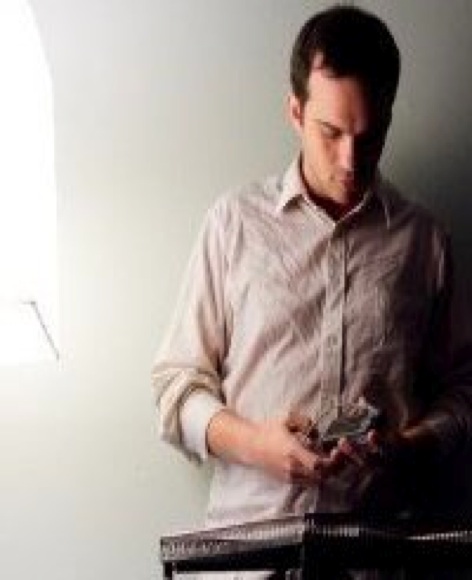 Matthew Henriksen is the author of Ordinary Sun (Black Ocean, 2011) and the chapbooks Another Word (DoubleCross Press, 2009) and Is Holy (horse less press, 2006). Some recent poems appear in Fence, Realpoetik, Raleigh Quarterly, Alice Blue Review, Sink Review, The Cultural Society, Handsome Journal and Two Weeks. He co-edits Typo, an online poetry journal, and publishes Cannibal Books, a book arts poetry press. From 2005 to 2008 he organized The Burning Chair Readings in Brooklyn and now hosts irregular readings throughout the country. A special feature of Frank Stanford’s unpublished poems and fiction, selected by Henriksen, will appear in Fulcrum #7. He lives and teaches in the Ozark Mountains.
Lee Balan
Ars Umbilicalis Poetica
(The Art of the Connection to the Poem)
A folded napkin could be blamed
When an accidental tug on the napkin’s edge
Caused a wine glass to tip and spill
This small misdeed
Led to snark remarks about stumblebums
Incriminations
And revelations about indiscrete behavior
Someone yelled “fire”
Which fed a full scale panic
Cosmologists tell us
Space is folded like the napkin
Within each fold there is more space
Each fold could be a new dimension
An alternate universe
Where there is another version of Earth
Of you Of me
Acting upon different decisions
Leading in new directions
Here I am
In the emergency room
With an IV in my arm
Feeling nauseous
There I am
Writing a prologue to a poem about accidents
I could be dead somewhere else
Yet still be alive
Folded napkin Folded space
A small misdeed could lead to catastrophe
Lee Balan was the first editor and art director for Beyond Baroque Magazine in Venice, CA. His poems and stories have been featured in several magazines including Phantom Seed, Sun-Runner, and Storylandia. He was the facilitator for the Tenderloin Writer’s Workshop in San Francisco. His background in mental health has been a major influence on his work. Lee has been the featured poet at several events and venues including the Palm Springs Art Museum. Recently, Lee self published his first novel Alien Journal.
.
 Inlandia: A Literary Journey