Roger Camp’s images have been published in over 100 magazines, most recently on the covers the The New England Review, Redivider, Kestrel, Lumina as well as in the NYQ, Antioch Review, Southwest Review, Chicago Review and the Harvard Review. He is the author of three books of photography, Butterflies in Flight, Thames & Hudson, 2002, 500 Flowers, Dewi Lewis Media, 2005, and Heat, Charta/DAP, 2009. His documentary photography has been awarded a Leica Medal of Excellence and a Graphis photographer of the year award. He has taught photography at The University of Iowa, Columbus College of Art & Design, and the Cite Internationale Universitaire de Paris. Additional examples of his work may be found at rogercampohoto.com. His work in this issue can be viewed here.
Author: inlandiajournal
Inlandia: A Literary Journey is the official literary journal for the Inlandia Institute. For more information visit www.inlandiainstitute.org.
Karen Greenbaum-Maya
Karen Greenbaum-Maya is a clinical psychologist in Claremont, California. She has been writing since she was nine. In another life, she was a German Lit major and read poetry for credit. She has placed poems and photographs in many publications, including Off the Coast, Umbrella, Abyss & Apex, qarrtsiluni, Poemeleon, Lilliput Review, In Posse Review, and Sow’s Ear Poetry Review. She was nominated for the 2010 Pushcart Prize. Her first chapbook, Eggs Satori, received an Honorable Mention in Pudding House Publications’ 2010 competition, and will be published in 2011. Her work can be viewed in this issue here.
J. Dub: The Gym of American Dreams
Geometry of the Winter Desert: Field and Home
Big Donna and the Medjools
Many Queens at the Indio Date Festival
A Sacred Gem: San Secondo d’Asti Church in Guasti, CA
A Conversation with Susan Straight

For the past two years, award-winning novelist Susan Straight has been serving as Inlandia’s very first Literary Laureate. A post of distinction, this position was created to highlight the talented author’s of Inland southern California by bringing their work to the people on a very personal level. To that end, Susan has been sharing her deep connection to the region and love of literature with the Inlandia community through writing workshops (to which she sometimes brings her own homemade cupcakes) and a new essay series for KCET, Notes of a Native Daughter, in which she documents places around the Inland Empire that are personally meaningful to her.
As Susan Straight’s two-year term as Inlandia’s first Literary Laureate comes to a close, we at Inlandia: A Literary Journey wanted to take the opportunity to ask her some questions about her work and her relationship with this region that many of us call home.
* * *
Inlandia: A Literary Journey: As a novelist and essayist, all of your work seems informed by ‘place’; to what do you attribute your strong ties to the Inlandia region?
Susan Straight: I was born here, as you and many readers may know, and every single day that informs my life, and my writing. I was born at Riverside Community Hospital, went to University Junior High, North High, Riverside City College, then went to USC. I began writing fiction and essays when I was sixteen, in an RCC Creative Writing class with a wonderful professor named Bill Bowers, who passed away before my first book came out. But I didn’t really write well about my place until I went off to Massachusetts for graduate school, already married, living in the snow in Amherst, and missed my landscape with a passion. I wrote most of my first book, Aquaboogie, during those two years, and then during five years after I returned and was living in a series of apartments downtown. Walking around downtown, going to the library, teaching at RCC, mailing my first stories at the downtown post office to literary journals, I came up with Rio Seco. I spent a lot of time in the orange groves and at the Santa Ana River, writing.
I.L.J.: Your fiction routinely mentions real place names, like Mecca, a remote census-designated area of the I.E., while others are fictionalized, like Rio Seco, a dead ringer for the real city of Riverside. Are there advantages to mixing real & fictionalized places? Or, how did this strategy come about for you?
S.S.: I named this area Rio Seco so that I could move around geography and make it a fictional place, like William Faulkner did for his Mississippi area. But neighboring places, like San Bernardino and Pomona and Mecca, should stay what they are, I felt. For Highwire Moon, I invented a fictional Tourmaline which was modeled on Garnet and Cabazon. But my vision of The Salton Sea and the vineyards of Mecca were based on many visits there.
I.L.J.: During your term as Inlandia’s Literary Laureate, you conducted a workshop through a local elementary school who read your novel for children, The Friskative Dog, a story set in Rio Seco, as well as a workshop for teens who read Highwire Moon, set in various places in the I.E. including Rio Seco and Mecca. Do you find that the young people can identify more easily with the work if it is set in a familiar locale?
S.S.: I think young people in our area haven’t seen stories and essays about this place, or people like them, very often, and so I think they really connect with characters like Elvia, who lives in the desert, was raised in a foster home in Rio Seco, and then travels to Mecca, because they see themselves or their family and friends represented in her. Serafina, the mother, is from Oaxaca, and countless teens in LA, Riverside, and other counties have told me how much she is like their migrant mothers. Younger schoolkids have said they liked The Friskative Dog because it’s about a girl who lives in an apartment, like they do…
For my new novel, Take One Candle Light a Room, which has settings in Los Angeles, Rio Seco, the orange groves and Santa Ana River, as well as Louisiana, I’ve had people all over the country tell me they like the idea that some of us stay forever where we were born, and some of us leave, and the characters who struggle with that are interesting to readers.
I.L.J.: You have also been writing a series of essays for KCET, Notes of a Native Daughter, which takes the reader into places unique to the region. There is such an immediacy to the details in your essays that readers are instantly transported. Do you physically go to these places to write, or what is your method?
S.S.: I love this new series for KCET. I always go physically to these places – Doug McCulloh is sometimes with me, and sometimes he goes separately. We drove to Hemet for “Sierra Dawn”, and to Nuevo to see the sheep ranch we wrote about. We went to Anza Narrows for that piece, and to Agua Mansa for the essay about that astonishing cemetery.
I.L.J.: Finally, you’ve lived in the Inland Empire all of your life. Do you have any favorite places, places that you feel most at home, or that may be under-appreciated or virtually unknown, that you’d like to share with our readership?
S.S.: I love the Santa Ana River, walking along the paths with my dog, thinking about what I’ve learned from Katherine Siva Saubel’s work about the Cahuilla people who lived near Mt. Rubidoux for hundreds of years, and who hunted along the river. I think about Anza and his party crossing there, and my brothers and I pretending we were Indians and collecting acorns, and the smell of the willows, and the sound of the coyotes at dusk. I love the orange groves everywhere, including Redlands and the lovely avenues of tall palms. I love Forest Falls and Mentone, the rocky washes where I like to hike. In San Bernardino, I love driving down Baseline or Mt Vernon, and I love remembering White Front, the store where my mother used to take us! Next week, I’m going to Mecca and Thermal and Oasis to write about the desert, another favorite place, and I can’t wait to have a date shake – my mother always took us there, too. I feel incredibly lucky to have this Inland landscape all around me.
* * *
Susan Straight has graciously agreed to sit on the jury panel to determine the next Inlandia Literary Laureate. Check back for an announcement in April.
Thank you, Susan, for all that you do for Inlandia.
* * *
 Susan Straight was born in Riverside and still lives there with her family. (She can actually see the hospital from her kitchen window, which her daughters find kind of pathetic; most days, she walks the dog past the classroom where she wrote her first short story at 16, at Riverside City College, which they find even more sad.) She has published seven novels and one middle-grade reader. Highwire Moon was a finalist for the National Book Award in 2001; A Million Nightingales was a finalist for the Los Angeles Times Book Prize in 2006. Her short stories have appeared in Zoetrope, The Ontario Review, The Oxford American, The Sun, Black Clock, and other magazines. “The Golden Gopher,” from Los Angelas Noir, won the Edgar Award in 2007; “El Ojo de Agua,” from Zoetrope, won an O. Henry Award in 2007. Her essays have appeared in the New York Times, Reader’s Digest, Family Circle, Salon, The Los Angeles Times, Harpers, The Nation, and other magazines. She was awarded a Guggenheim Fellowship to work on Highwire Moon, and a Lannan Prize was an immense help when working on Take One Candle Light a Room.
Contributor Bios
Kate Anger is a writer who teaches playwriting at the University of California, Riverside and UCR Palm Desert Low Residency MFA Program. Her work has appeared at the Los Angeles Theatre Center, Stella Adler Theatre, and Ensemble Studio Theatre, as well as UC Riverside and local theatres in the IE. Other writing has appeared in Faultline, Crate, Mosaic, the Press-Enterprise and Inlandia’s Online Journal.
Born in Las Vegas in 1979, Demond Black moved to Los Angeles in the 80s and spent his childhood moving from his parents’ in LA, his grandparents’ in Las Vegas and his Uncle’s in Manhattan. After graduating high school he briefly enrolled at Redlands University and wrote his first book “Limbo” about a group of recent high school graduates trying to figure out what to do with themselves as the main character goes through the motions of having and losing his first love. After a year of not being able to find a publisher his friends helped him self-publish it and they sold copies at campuses around Southern California pricing the book in such a way to just recoup printing costs. He was unsatisfied with this process of years doing odd jobs, going to school here and there and sharpening his writing skills through reading and constantly writing poetry. Settling down in Colton a few years ago after living in Oregon he felt he had moved past the themes covered in ‘Limbo’ and had something to say about his generation as a whole and “Slackass” is the result. Currently he is working on it’s prequel, “Sputnik”, and his sixth book of poetry, ‘Lady Luck is a Quadriplegic’. He blogs at slackass.wordpress.com.
Mark Cox teaches in the Creative Writing Department at the University of North Carolina, Wilmington and in the Vermont College MFA Program. His books are Smoulder (David R. Godine), and Natural Causes and Thirty-seven Years from the Stone, both published in the Pitt Poetry Series.
Shery Dameron was born in Maryland, and as an Air Force brat grew up in many states and lived for three years in France as a child. She has lived in Riverside California since nineteen-sixty -seven. She graduated from Rubidoux High School and has attended Riverside Community College off and on for the last thirty-eight years. In 2010 while at RCC she received the Student of Distinction Award from the English Department. She has had poems published in Slouching Toward Mount Rubidoux Manor, More Than Oranges, and in the Quaker publication What Canst Thou Say?
Charlotte Davidson was born and raised in Southern California. After college, she spent eleven years in Paris, France. Upon returning to the States, she received a Masters in English from Syracuse University followed by an M.F.A. in poetry from U.C. Irvine. She now lives in Riverside, California, where she runs an organic orange ranch and takes care of her six horses, five dogs, four cats, and one husband. She has published poems and stories in various journals and anthologies including The Santa Monica Review, Gulf Coast, The Fiddlehead, Faultline, and Poemeleon. She is expecting her first book of poems, Fresh Zebra, this fall.
Sheela Sitaram Free (“Doc Free”) was born in Mumbai, India and has spent equal halves of her life in India and in America. Her B.A. in English Literature and Language, M.A. in English and American Literature and Language, M.A. in Hindi, Ph.D. in the Contemporary American Novel-novels of John Updike-and her twenty four years of teaching all across the United States in Universities, colleges, and community colleges reveal her lifelong passion for the power of words especially in the context of world literature and writing. Her collection of poetry entitled Of Fractured Clocks, Bones and Windshields was published in February 2009 and nominated for the Association of Asian American Studies as well as the Asian American Workshop awards in 2010. She has been writing for over 20 years but it was the Inland Empire that inspired/motivated her to publish and she has simply loved being a part of it for 9 years now. It is home to and for her, and she draws on a great deal of material from it in her poetry.
Debbie Graber received an MFA from the low residency program at the University of California, Riverside. Her work has appeared in Hobart, Knee-Jerk and Word Riot.
Karen Greenbaum-Maya is a clinical psychologist in Claremont, California. She has been writing since she was nine. In another life, she was a German Lit major and read poetry for credit. She has placed poems and photographs in many publications, including Off the Coast, Umbrella, Abyss & Apex, qarrtsiluni, Poemeleon, Lilliput Review, In Posse Review, and Sow’s Ear Poetry Review. She was nominated for the 2010 Pushcart Prize. Her first chapbook, Eggs Satori, received an Honorable Mention in Pudding House Publications’ 2010 competition, and will be published in 2011.
Stephanie Barbé Hammer is a two-time Pushcart Prize nominee who has published fiction, poetry, and non-fiction in Square Lake, the Café Irreal, CRATE, Hot Metal Bridge, Locus Novus, NYCBigCityLit, Argestes, Soundings, Pearl, Hayden’s Ferry and the Bellevue Literary Review. An intermittent actor, she has performed poetry at Beyond Baroque and makes a spectral appearance in Erika Suderburg’s film Somatography. Both an instructor and a student, she teaches Comparative Literature at the University of California, Riverside (where she has been a faculty member since 1986), and studies writing at the Whidbey Island Writers Residency.
Jackie Haskins is a biologist of wild wet places, from cypress swamps to glacial cirque swales. She is also an MFA student at the Whidbey Writer’s Workshop. Jackie’s fiction has received finalist in Glimmer Train’s Short Story Award for New Writers, second place in a Lunch Hour Stories contest, and first in a Soundings Review contest. Jackie’s poetry, fiction, or creative non-fiction have appeared or will soon appear in Raven Chronicles, Meadowland Review, Shark Reef Literary Magazine, Six Minute Magazine, Soundings Review, and Bacopa Literary Review.
Jonar Isip lived in Corona, California for over a decade before moving back to Santa Ana. In that span of time, he attended the University of California – Riverside, earning a BA in Creative Writing. He also participated in the Community of Writers at Squaw Valley, California, as well as the Idyllwild Arts program. Jonar currently works and writes in Orange County, but often visits Corona to see friends, family, and his dog, Bam Bam.
Photography is a lifelong avocation for Riverside writer, educator, potter and transpersonal psychotherapist, Joan Koerper who holds a Ph.D. in Humanities. Joan has published a book of creative nonfiction (UMI, 2004), memoir, poems, fiction and nonfiction in such venues as Sacred Fire (Adams Media), Moondance, Clay Times, Inlandia publications, radio scripts, videotape scripts and audiotape scripts for children. Joan has taught graduate and undergraduate courses at four universities. She and her dog Sage have just completed their novel Dumped, Dazed and Dazzled for young readers, generously illustrated with Joan’s photos.
W.F. Lantry, a native of San Diego, spent many years walking the deserts and climbing the coastal mountains of Southern California. He holds a PhD in Literature and Creative Writing from the University of Houston. In 2010 he won the Lindberg International Poetry for Peace Prize (in Israel), Crucible Poetry Prize, CutBank Patricia Goedicke Prize and National Hackney Literary Award in Poetry. Recent work has appeared in Asian Cha, Tower Journal and Aesthetica. His chapbook, The Language of Birds (Finishing Line Press 2011), is a lyric retelling of Attar’s Conference of the Birds. He works in Washington, DC and is a contributing editor of Umbrella.
Marcia LeBeau has had poems published in Rattle, NO/ON: Journal of the Short Poem, Poemeleon and Inertia among others. She was named “Most Outstanding Writing Coach”by New York Scores, an after-school literacy program She has an MFA from Vermont College of Fine Arts and lives in New Jersey with her husband and son.
Kim Lohse holds degrees from Hunter College (BA) and Vermont College (MFA) in Creative Writing. Her work has appeared in Margie, Caesura, The Squaw Valley Review and in 2006, she won an Iowa Source Poetry prize and was also a finalist for the Dana Awards. In addition to writing poetry, Kim translates early French surrealist poetry and essays and received a certificate in translation from Vermont College. Some French translations most recently appeared in Pilot (pilotpoetry.com). She has worked as a programming director for Poetry Center San Jose and the Squaw Valley Writer’s Conference. In Palo Alto California, she teaches English and Creative Writing. She has an eight-year-old daughter and lives in Redwood City, California.
Matthew Nadelson is an English instructor who lives in Riverside, CA, where he spends his days undermining the assumed power structures and squabbling with the sparrows for the spare crumbs occasionally rained down from the hands of those in power. His first poetry collection, American Spirit, was published in September 2011 by Finishing Line Press.
Richard Nester teaches at UC Irvine. This is his second publication in Inlandia. The experience referred to in the poem occurred on a family vacation when his son was young and when he himself was still athletic enough to ride along.
Jay Rubin, raised in So Cal, now teaches writing at The College of Alameda in the San Francisco Bay Area and publishes Alehouse, an all-poetry literary journal. He holds an MFA in Poetry from New England College and lives in San Francisco with his son and Norwich terrier.
Will Vincent is a poet and a student in the MFA program at Sarah Lawrence College. His poems have appeared in Scythe, Word Magazine, the Matchbook Story shortlist, and Chinquapin Magazine. His poem “Tree Fort” was the winner of the inaugural UCSC broadside contest in 2010. Though he currently resides in Yonkers, NY, he is from Los Olivos, and more importantly, the hills, beaches, and dust of southern California.
Ontario Creative Writing Workshop at the Ovitt Family Community Library
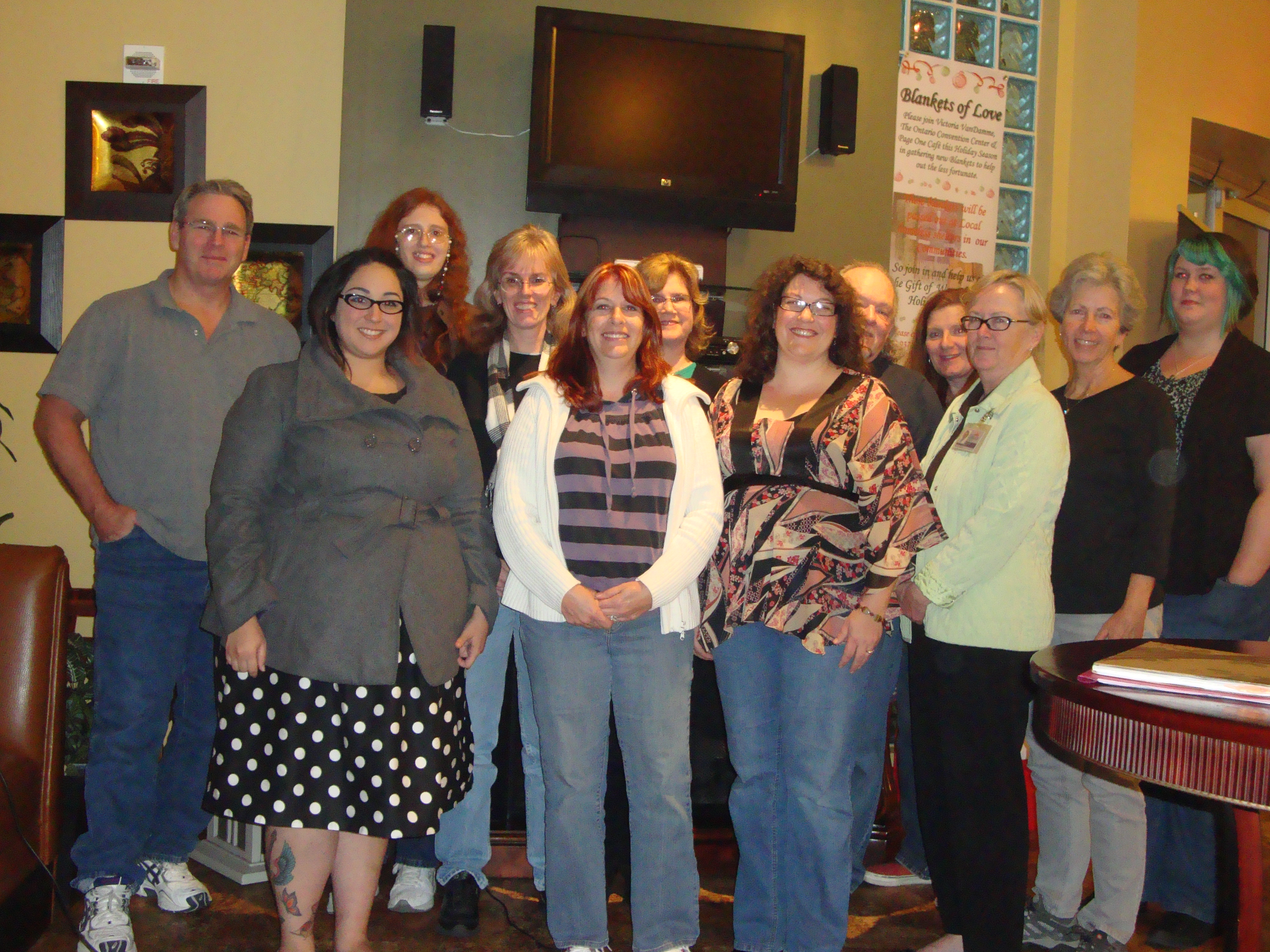 Clockwise left to right, starting with back row: Mike, Samantha, Kate, Marsha, Larry, Elizabyth, Kathryn, Shelby, Janis, Cati (workshop leader), Kelly, and Lauren.
Inlandia Creative Writers Workshops Feature – Ontario Nominated by workshop leader Cati Porter
Usually this space is reserved for a single author, a featured workshop participant nominated by their respective Inlandia workshop leader. However, this issue I am taking the liberty to nominate my whole group. I am very proud of each and every one of them.
This was the beginning of our very first season of workshops at the Ovitt Family Community Library in Ontario. For our first meeting, the room was a packed twenty-four. Over the next ten weeks the number of participants fluctuated but never dipped below twelve as we discussed craft topics designed to help strengthen the works-in-progress and applied strategies for getting around “writer’s block”. By the end of the Fall session, it was time for Inlandia’s annual Creative Writing Workshops Showcase, where each workshop participant from the preceding year has the opportunity to present their work in front of a live audience. It is also the event at which we launch the annual Writing for Inlandia anthology. But because our group was so new we were not eligible for inclusion in the anthology, or as readers for the showcase. While several members did choose to attend, in anticipation of being included next year, we decided that it would be fun to hold our own celebratory end-of-the-session reading. The photo at the top of this post is from that event.
Our new Winter session has now begun with several returning participants. Due to some administrative changes we are now meeting in the library’s very own Page One cafe, rather than in the meeting room; one “perk” to this is that workshop participants have access to a wide variety of coffee beverages and a dessert tray provided by the generosity of the Ovitt Library.
As Inlandia’s newest creative writing workshop leader, it has given me great joy to be able to share my love of literature with an energetic and talented group of like-minded individuals. While not everything went as planned (when does it ever?!) my Ontario workshop has gotten off to a great start and I look forward to continuing for years to come.
 Inlandia: A Literary Journey