KIDLANDIA: Giving Gifts of Meaning by Julianna M. Cruz

I hope that everyone is able to find that perfect gift for their loved ones this holiday season, but as I say that it reminds me that there is really no way to wrap the gifts that are at the top of my list (health, happiness, and love for all my family and friends). I know many children write long lists that include the latest toys and technology, but I hope that somewhere on that list is a special wish for others. Also, I’d like to take this opportunity to plug local, small business. I plan on making as many local purchases as I can—there are just so many talented artists and crafters in our area—we must support them. If you would like to find that unique gift, be sure to stop by the Alternative Gift Fair this Sunday. I will be there selling and signing books at the Inlandia Institute’s table, and there will be many local artists and crafters selling their wares.

I checked the weather report and it looks like it will be a great day to shop outside. Please go to the Facebook link for more details. I hope to see you there!

When: Sunday, December 7, 2014

Where: Methodist Church, 4845 Brockton Ave, Riverside, CA

Time: 11-3pm

Why: To support local authors and artists—and find that unique gift that you cannot find at Walmart. 🙂

Happy Shopping.


Julianna M. Cruz is a teacher, a author, and an Inlandian.


2014 Pushcart Prize Nominees by Cati Porter

For the first time, Inlandia is proud to announce that we have nominated the following works for this year’s Pushcart Prize Anthology, an annual anthology of works culled from little magazines and independent presses. Editors may nominate up to six works, and can be any combination of fiction, nonfiction, poetry, and stand-alone excerpts from longer works published or scheduled to be published during the current calendar year. This year, we have nominated the following:

From Inlandia: A Literary Journey

Kathleen Alcala’s “La Otra”

Elisha Holt’s “Geology”

From Orangelandia: The Literature of Inland Citrus

Juan Delgado’s “Walter’s Orchid”

Casandra Lopez’s “Those Who Speak to Trees Remember”

Chad Sweeney’s “World”

From No Easy Way: Integrating Riverside Schools – A Victory for Community by Arthur L. Littleworth

Congratulations to all of our nominees!

And to all of our contributors, we wish we could nominate all of you!

Giving Thanks to Writers by Victoria Waddle

While this weekend is the official beginning of the season of hysterical consumerism, it is also the dawn of the season of thanks. We’ve just crossed the threshold—Thanksgiving—and will continue in our journey of gratitude through the new year, when loved ones and the less fortunate move us to act on our better impulses.

Those of us who are ‘bookies’ have another group to add to our gratitude list. Writers. Ask most avid readers, and they’ll tell you that books have saved their lives. They aren’t speaking metaphorically. Through the power of others’ words, readers learn first to live, and then to tell, their own stories.

This symbiotic relationship between readers and writers has been detailed in several recent young adult and adult bestsellers. The most popular recent novel in which a reader seeks a writer is The Fault in Our Stars by John Green. So pervasive are the book and the movie that I probably don’t need a spoiler alert when I say that that journey doesn’t go as planned. And yet what a transformational journey it is. Up and coming author Rainbow Rowell does a brilliant job of taking her protagonist on the journey from reader to copycat writer and finally, to a young woman telling her own story in Fangirl. Ruth Ozeki transcends space and time in A Tale for the Time Being to bring together an adolescent diarist from Japan and an author living on a remote island off of British Columbia when the girl’s journal, housed in a Hello Kitty lunchbox, washes up on the author’s shore.

This season, in an act of gratitude for writers who toil on worthy but lesser-known projects, why not make a promise to dig deeper and make a connection to authors unknown to you? As a starter, I’m recommending Out There by Sarah Stark, published this spring by the independent Leaf Storm Press.

Out There is the story of Jefferson Long Soldier, just home from two tours in the Iraq War. Wearing the high-top sneakers he’s beaded and a headband he’s finger crocheted from plastic sandwich bags, he nervously walks on his hands in the Albuquerque International Sunport to engender the courage it will take to cross the “security barrier, to the free world, to Esco and Cousin Nigel and home.” Jefferson senses that there are “snipers in the airport, explosive tumbleweeds on the highway, insurgents in stolen minivans, undercover extremists buying lattes in front of him and single mothers wired for explosives behind.” Yes, his war experience has left him with PTSD, but he has a plan for getting better. He knows that reading One Hundred Years of Solitude throughout his service has saved him. He still has the novel strapped to his chest with an Ace bandage, and many of its words seared into his brain, words that he has recited to fellow soldiers, that he reviewed whenever someone he knew—or had just met—died.

Since One Hundred Years of Solitude has saved Jefferson, he knows that he must find its author, Nobel Prize winner Gabriel Garcia Marquez—GGM as Jefferson thinks of him—and ask him the big question, why? He knows GGM will understand all that he has been through because, upon returning from war, the character Colonel Aureliano Buendía is asked where he has been. He replies, “‘Out there,’ an incomprehensible faraway place. As in, you cannot understand where I have been.”

In taking the road trip from Santa Fe, New Mexico to Mexico City by motorcycle, Jefferson doesn’t know if he will achieve his goal. Garcia Marquez is very sick with cancer and a recluse. Jefferson is not sure where he lives. Yet, as we know, the journey itself is often the destination. The danger, beauty and transcendence of the crossing are illuminated with poetic language. Jefferson experiences both people and events as magically real and otherworldly as GGM himself would have enjoyed. And Jefferson will find what he seeks—that “large, unidentified piece of his spirit” that had gone missing, had remained behind in the war.

Jefferson’s reunification with his deeper being is brought about by his ability to take the language of GGM, which “had been a blanket of comfort ever since the night Ramon from Las Cruces was shot in the throat, two feet from Jefferson,” and transform it. He moves from chanting the novel’s lines as a form of eulogy to altering and rearranging those lines until he has created a paean to life and the living.

While most of us have the good fortune not to have gone to war, we have, in other senses, been ‘out there.’ Writers have brought us back with the right words at the right time—words that we inhabit as they inhabit us, until finally, we speak our own language. That’s worth being grateful for.

KIDLANDIA: Give Thanks and Praises by Julianna M. Cruz

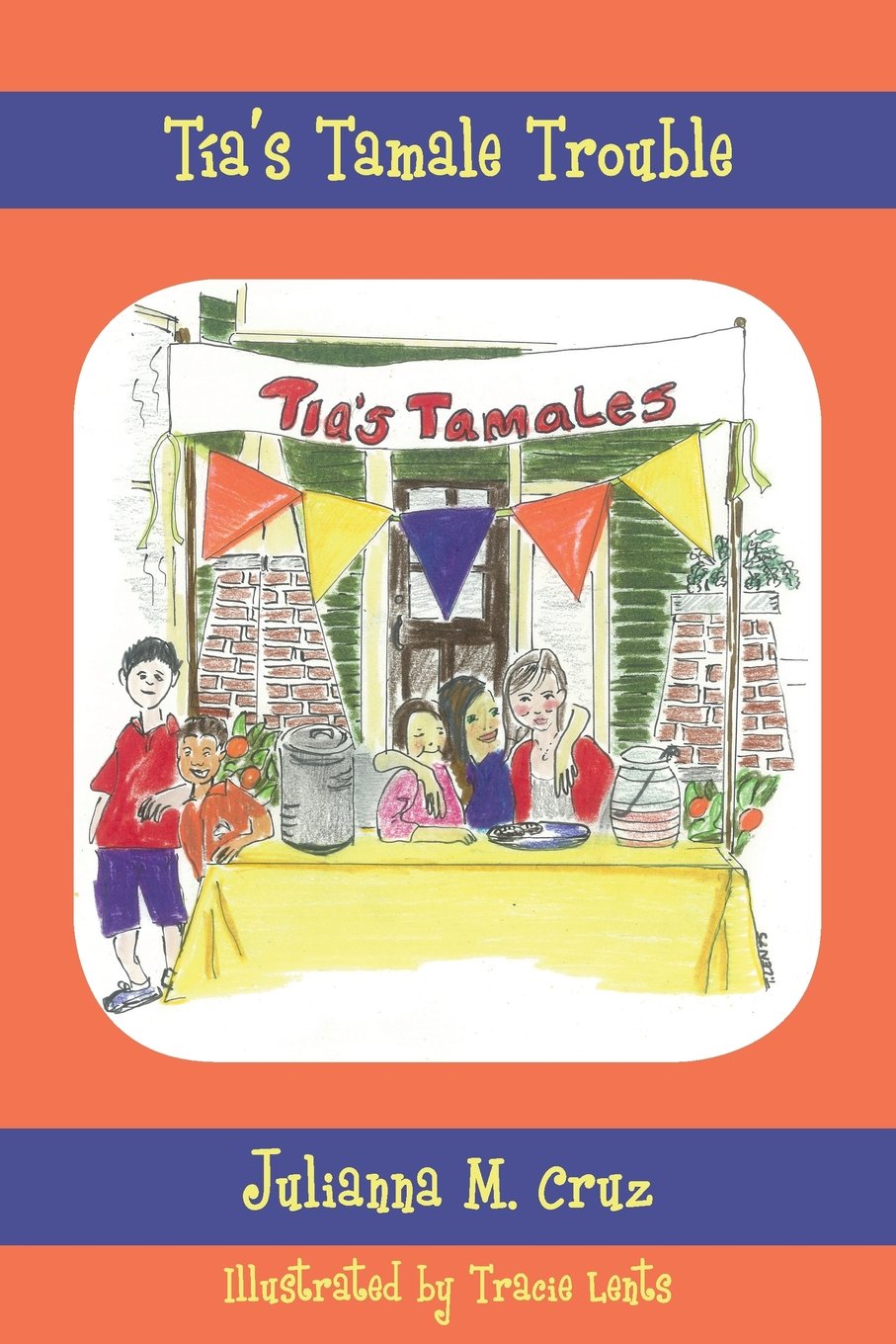
I am truly grateful for the fountain of support that I always receive from family and friends. It was so uplifting to see so many familiar, smiling faces at the launch of my newest book, Tia’s Tamale Trouble. Amazingly, we sold all of the books that we brought to the event. If you didn’t get a chance to get your copy, and you would like one for yourself, or to give as a gift, please leave a comment and send me an email so we can arrange to get you a signed copy. It was so fun to watch my friend, and fellow Bryant teacher, Tracie Lents (the illustrator) tell all the children about the process of illustrating our book. They also were very excited to take part in her turkey coloring contest. Winners will be displayed in the Taylor Gallery at the Riverside Art Museum—and the winner will also receive a signed copy of Tia’s Tamale Trouble. I can’t wait to find out who the winner is!

Thanks and Praises must also be given to everyone at the Inlandia Institute that helped bring my vision to reality—I couldn’t have done it without you! A special thanks to Cati and Larry who carried my baby all the way through to the end. I know and appreciate how hard you worked.

71dcb6c-krl

Thank you! Thank you! Thank you!


Julianna M. Cruz is a teacher, a author, and an Inlandian.

For All Those Who Ask, What *is* Inlandia? by Cati Porter

Once again we are approaching that time of year when we give thanks for friends and family, take stock of what we have accomplished, and express appreciation for all those who have made it possible. So, thank you—we are all Inlandia.

A question I get asked regularly is, what is Inlandia? We have now been writing these columns for well over a year, and I don’t think we have ever addressed that directly here. Sure, you can make out who we are by the patchwork of topics covered here; what you see is what Inlandia is and does: many voices, all hailing from Inland Southern California, celebrating the region. But on the heels of what has been a banner week for Inlandia, I thought I would try to explain it in a little more detail.

The Inlandia Institute was established in 2007 as a partnership between the City of Riverside and Heyday, our co-publisher, after the publication of the anthology Inlandia: A Literary Journey through California’s Inland Empire. The idea was to found a literary and cultural center here in the Inland Empire that focused on the writers and readers of the region. Soon after, Inlandia moved into our own office, incorporating in 2009, and in 2012 Inlandia was granted non-profit status as a 501(c)(3).

Inlandia has five core programs: Children’s Creative Literacy, Adult Literary Professional Development, Publications—both with our co-publisher Heyday as well as a locally-produced independent imprint, Free Public Literary Events, and the Inlandia Literary Laureate. What does this translate to? Just this past year, Inlandia has:

– Served over 2000 children, including at-risk youth through The Women Wonder Writers program of the DA’s office, resulting in a collection of written work and a public reading and discussion; and in programs in Title 1 schools like Fremont Elementary, where we held a book discussion and gave all 200 fifth-graders and sixth-graders a free copy of Gayle Brandeis’ young adult novel, My Life with the Lincolns, thanks to a generous Rotary sponsorship.

– Served over 2400 adults through public outreach events like Celebrate Mount Rubidoux and the Mayor’s Celebration for Arts & Innovation, and by hosting free monthly author events during ArtsWalk at the Riverside Public Library, and writing workshops throughout Riverside and San Bernardino Counties, including a Family Legacy Writing Workshop at the Goeske Senior Center.

– Published: No Easy Way, the story of the integration of Riverside schools, by Arthur L. Littleworth, a chapter integral to Riverside history; Vital Signs by Inlandia Literary Laureate Juan Delgado and Tom McGovern, which went on to win an American Book Award from the Before Columbus Foundation; and the Orangelandia anthology, which contains the fruit of Riverside’s citrus heritage. And launching this week, a new children’s chapter book, Tia’s Tamale Trouble, by Inlandia author and educator Julianna Maya Cruz.

Inlandia also undertakes special projects from time to time, like “Making Waves in Inlandia,” which chronicles the stories of the women’s environmental movement through oral histories and a very cool interactive component on our website, including a map of all the spaces saved by local environmental activists, and video interviews.

We also have two other interactive features on our website—a map that details the location of every Inland Empire site mentioned in our flagship Inlandia anthology (which, regrettably, is currently out of print—but we are working on a second edition! More about that in a future post). And, just this past week, with the publication of No Easy Way, we launched an interactive timeline, “Time Travel through Riverside’s School Integration History.”

Further, after the first of the year, we will be launching a six-part series of monthly public civic discussion forums featuring esteemed panelists and partner organizations, with the kickoff event at UCR’s Culver Center on January 31, 2015, at 1 pm.

One of the sound bites associated with Inlandia is, “celebrating the region in word, image, and sound.”

Planned projects include a new Adopt-a-School program which will bring literary arts education, taught by professionals in the field, to area schools; a Native American Voices conference at the Dorothy Ramon Center in Banning, featuring and celebrating indigenous peoples; a writing workshop at the Ontario Museum of History and Art celebrating black aviators in February, in honor of Black History Month. Not to mention our usual monthly Arts Walk series at the downtown Riverside Public Library and the free writing workshops held in six different cities throughout the region.

We are supported wholly through the generous donations of our members, supporters, and through grant funding from organizations like the City of Riverside, the Riverside Arts Council, the E. Rhodes and Leona B. Carpenter Foundation, and Cal Humanities. But like any arts organization, we are constantly thinking of creative ways we can ensure continued funding while also making it fun for contributors. Last week, we participated in the county-wide Give BIG day of giving, and to all of those who helped us meet our goals, thank you!

We are also currently in the midst of a book fair fundraiser sponsored by Barnes & Noble. If you missed the kickoff event on Saturday November 22, which featured readings by notable locals Larry Eby, Isabel Flores, Stephanie Barbe Hammer, Julianna Cruz, and a flurry of contributors to the Orangelandia anthology, know that you can still participate through the end of the week by shopping online or in store (any Barnes & Noble anywhere, as long as you have Inlandia’s code: 11484482), through Black Friday. So if like most people at this time of year you are beginning to think about holiday gifts, give a gift to Inlandia when you shop at Barnes & Noble this Thanksgiving week.

From all of us at Inlandia, we give thanks for you this week, and every week, throughout the year.

Tomás Rivera and Civic Morality by Carlos Cortes

When Tomás Rivera became chancellor of the University of California, Riverside, in 1979, he accepted both the honor and the burden of being a first: first Chicano chancellor, first minority chancellor, and youngest chancellor in the history of the University of California system.

Tomás earned plaudits nationwide for his accomplishments. Partly because of his firstness, he also became the object of national attention, serving on numerous prestigious boards, committees, and task forces, including the Los Angeles Times Board of Directors. Moreover, beyond his administrative firstness, Tomás also garnered literary acclaim for such works as his novel (. . . and the Earth Did Not Devour Him) and his poetry (“The Searchers”).

But, as inevitable for most firsts, Tomás also bore a heavy burden, the relentless pressure of knowing he was constantly being viewed as a representative, maybe even the embodiment, of his people. He lived continuously with the terrible knowledge that any of his perceived missteps or failings would be interpreted by some as definitive proof of the inadequacy of Mexican Americans. That burden ultimately contributed to his death from a heart attack in 1984.

In the aftermath of his death, Tomás reemerged as a Latino symbol. His name soon adorned schools, centers, prizes, and, of course, UCR’s Tomás Rivera Library. Yet, while Tomás attained enormous symbolic importance, his real life administrative accomplishments received little serious assessment for nearly three decades. Then, in the fall, 2013, Professor Tiffany López, holder of UCR’s Tomás Rivera Endowed Chair, organized a seminar dedicated to analyzing Tomás’ speeches and writings concerning the role of higher education administrators, particularly Latino administrative leaders.

From that careful and astute examination of those documents, the seminar identified one core idea that illuminated the trajectory of Tomás’ administrative life: his commitment to the concept of civic morality. Again and again Tomás proclaimed that college administrators should lead with the goal of spreading and inculcating a sense of civic morality, a basis for fostering a more equitable society.

During the seminar, Tiffany invited me, as Tomás’ friend and a 26-year UCR History professor, to spend a couple of hours with her students, sharing my observations of and experiences with Tomás. Later Tiffany asked me if I would participate in a theatrical piece she was developing based on the seminar. Intrigued by the idea of a seminar on college administration being transformed into a theatrical presentation, I said yes. Yet the cynic in me knew that an administration-oriented seminar could not possibly become effective theatre. How wrong I was!

While the expression “blown away” has become a cliché, that is precisely how I felt when I participated in the first performance of “Civic Morality” on December 3, 2013, before a packed house at UCR’s Culver Center of the Arts. Riversiders will get another opportunity to see how wrong I was when Tiffany’s theatrical presentation, “Civic Morality,” about the life of Tomás Rivera, is presented again at 7 pm on Wednesday, November 12, at the César Chávez Community Center Auditorium in Bobby Bonds Park, 2060 University Avenue.

“Civic Morality” is as difficult to describe as it is impossible to resist. Both Tiffany’s opening narrative, which sketches the contours of Tomás’ administrative career and the evolution of his thinking, and the students’ heartfelt reflections on their engagement with Tomás’ writings provide drama and insight into the life and ideas of this remarkable man. When the students had finished their parts and I made my way to the Culver stage to share my recollections of Tomás, I felt both the joy of personal revelation and the onus of responsibility of helping bring Tomás to life for an audience of many who had never known him.

Tomás Rivera was far more than a first; he was unique. With his sly smile and mischievous sense of humor, he could charm. A man of virtually limitless personal generosity, he gave himself to everyone almost without reservation. He and his wife, Concha, hosted more than 200 events each year in the Chancellor’s residence. No matter how imposing the administrative pressures, Tomás would somehow make time to answer a local teacher’s request to speak to her elementary school class. An academic leader who never forgot his farm laboring family roots, he always remained part of the people.

The life of Tomás Rivera, particularly those last five sometimes joyous, sometimes tumultuous, always challenging UCR years, provide the stuff of tragedy and triumph. “Civic Morality,” which captures both the tragedy of Tomás’ death and the triumphant timelessness of his vision, serves as a moving tribute to a good and, in some respects, great man. I hope that many of you will be able to join us on November 12 for this dramatic exploration of a life worth recalling, cherishing, and emulating.

Other Desert Mothers: Ruth Nolan at Riverside Art Museum by Lisa Henry

Tonight, Friday November 7, Salt+Spice will present author, educator, and environmental activist Ruth Nolan, who will launch her latest collection of poetry, Other Desert Mothers, at the Riverside Art Museum. A wine and cheese reception will begin at 6:30pm with the reading set to begin at 7:00pm.

Ruth Nolan knows more than a few things about the desert, and about motherhood. A native of the Inland Empire and a current resident of Palm Desert, Nolan has spent countless hours hiking, camping, writing, parenting, grandparenting and firefighting in the vast, dry landscapes of California’s deserts. Her new collection of poetry, Other Desert Mothers (Old Woman Mountains Press, 2014), is a meditation on her unique desert journey. The book will be released in November and Nolan will celebrate the publication with a reading and reception at Riverside Art Museum Friday November 7 at 6:30pm.

A long-time desert dweller, Nolan has experienced adolescence, motherhood, and now grandmotherhood in and around the Mojave Desert.

“My parents moved us to a very remote area of the Mojave Desert when I was 13, from Rialto, CA.” It was a difficult transition for Nolan. She readily admits, “I was in shock at the vast contrast between the Inland Empire and desert, but instantly smitten and blown away by the beauty and power of the desert. I’ve been pinned down by the desert, both literally and metaphorically, since then.”

As single mother and a professor of English and Creative Writing at College of the Desert, both Nolan’s personal identity and professional career have been forged in the vast and surreal landscape, which she describes as “my #1 geography.” This place is “a sort of complete dreamscape, an altered state that both inspires, elates, and intimidates me. I have only to step into the desert on a hike or start a road trip across its vast, empty roads, and I feel that sense of unbroken dreamscape again.”

Nolan has fully embraced her hometown as rich and fertile ground where she can write, study and teach. An avid desert advocate and conservationist, she lectures widely on literature of the desert, and has taught desert-based writing workshops for the Desert Institute at Joshua Tree National Park. Among her many notable publications are No Place for a Puritan (Heyday Books/Inlandia, 2009), an impressive anthology highlighting the diverse literature of California’s deserts, Orangelandia: The Literature of Inland Citrus (Inlandia, 2014) and New California Writing, 2011 (Heyday).

“For me, the Mojave hasn’t been a wasteland; nor, even as it’s been discovered by artists more recently as a highly desirable location for a more refined, esoteric aesthetic. The Mojave Desert is a free-flowing experience of consciousness and geography. It’s a place of life, a place of people—however far apart, a place of sustenance and nurturing and enlightenment.”


Lisa Henry teaches at San Bernardino Valley College and is founder of Salt+Spice, a community-based arts organization.

Bats in the Belfry by Joan Koerper

It’s true. My first encounter with bats actually was in a belfry: the bell tower of St. Cecilia’s Catholic Church on Livernois Avenue in Detroit, Michigan. Entry to the tower was forbidden to all but a chosen few. I’d begged my father, who was the organist at the church, to be my partner on an adventure and climb the long, winding staircase of the looming, mysterious bell tower. As an avid reader of mystery stories my nine-year-old imagination ran wild with excitement. Would we find the “secret of the bell tower?” Or the “mystery of the hidden staircase?”

One Saturday in October, Dad granted my wish as part of my birthday present that year. After his long morning of playing daily mass, funerals, and weddings he drove ten miles home to West Bloomfield, fetched me, and we headed back to the church for our rendezvous with the unknown.

The tumbler clicked in the wide, heavy, sculpted, solid wooden door as Dad’s key turned in the lock. Our footfalls echoed off the stairs against the cement walls of the narrow, curving passageway. Higher and higher we ascended. My heartbeat quickened until we reached the first open space with floor to ceiling vertical slits in the exterior walls. Then, mounting even narrower, twisting steps, my heart raced as we reached the steeple and confronted the beauty of the bats, the bells, and the view. It was a dream come true, one of the thrills of my young life.

I wasn’t afraid of the bats in the belfry. My father would never put me in danger. As an educator, he educated me. I knew we wouldn’t be “attacked,” and that it was extremely rare for bats to be rabid. Instead, we were visitors in their home.

I’ve had many other encounters with bats since then: while in Detroit, as an Investigative Police Officer (detective) searching old buildings, attics, and cupolas for young missing children, and working crime scene venues. And in caves I’ve explored across the country. While living in Northern Minnesota, I was introduced to the idea of bat houses. My friends the Kargers, along with other residents, specifically built and positioned houses for bats who were especially welcomed for their role in consuming mosquitoes and other flying insects in summer. Now, living in Wrightwood, I’ve observed a number of homes also providing bat shelters.

In western society in particular, bats get a bad rap. Some say it is because bats are nocturnal, creatures of the night, and part of the “dark side” because they go into damp, dark places, make no noise, and are mysterious. Whatever the reasons, misconceptions and superstitions surround bats, especially in western society, fostering fear, and even panic. Simply put, humans too often fear what we don’t know and are all too ready to declare the unknown as “evil.” Wildly exaggerated rumors, such as the common misconception that bats are rabid, abound. Or that they are some sort of flying rodent, or closely related to rodents, when they are actually more closely related to primates than rodents.

Last week, on October 28, I was standing in the Wrightwood Branch of the San Bernardino County Library, admiring the images and figures of bats hanging from the ceiling as part of the Halloween decorations when I found the book, America’s Neighborhood Bats: Understanding and Learning to Live in Harmony with Them by Merlin D. Tuttle (University of Texas Press) on a Friends of the Library sale shelf. I snatched it up. This beautifully produced book with full color photographs, intended to educate the general public about bats, won the Conservation Education Award by the Wildlife Society. The author, Tuttle, is the founder and science director of Bat Conservation International in Austin, Texas.

Once home, I read it in one sitting. Soon I realized I should have been sipping a margarita or tequila sunrise while reading.

Yep, heads up tequila drinkers! Without bats there would be no tequila! Tuttle reveals, “agave plants, from which tequila is produced, are so dependent on bats for pollination that without them, the probability of successful seed production drops to one three-thousandth of normal.”

In light of the astonishing information I learned about bats, I thought it might be fun to briefly recount a few bat facts here:

  • Bat fossils have been found that are approximately 50 million years old, and today’s bats closely resemble those ancient bats.
  • Bats are mammals: the only flying mammals at that. Bats account for one-quarter of all mammal species. Scientists have placed them in their own group, Chiroptera, which means “hand-wing.”
  • There are nearly a thousand species of bats that come in a fascinating array of appearances.
  • The Bumblebee Bat of Thailand, the world’s smallest mammal, weighs less than a penny, whereas the Flying Foxes of the old-world tropics can have six-feet wing spans.
  • Bats are not blind: many have excellent vision.
  • Bats hunt by echolocation, or emitting high-frequency sounds that bounce back to their ears. This enables them to detect minute objects in complete darkness. Their unique echolocation systems “surpass current scientific understanding and on a watt-per-watt, ounce-per-ounce basis has been estimated to be literally billions of times more efficient than any similar system developed by humans.”
  • Most bats living in temperate zones in the US and Canada mate right before entering hibernation in the fall.
  • Like humans, bats give birth to poorly developed offspring and nurse them from pectoral breasts.
  • Bats can live up to forty years producing only one offspring a year, although few survive more than thirty-four years.
  • They are clean, cuddly and sociable.
  • Seventy percent of bats eat insects, though many tropical species feed on fruit or nectar exclusively. A few are carnivorous, eating small vertebrates: fish, frogs, mice and birds. Of the nearly 1,000 species of bats, only three species are vampire bats and they live only in Latin America.
  • Insect eating bats are essential to keeping night-flying insects in check including beetles, moths and mosquitoes. For example, “the 20 million free-tailed bats from Bracken Cave in Central Texas eat more than 200 tons of insects in a single midsummer night.”
  • Pollination and seed dispersal activities of nectar and fruit eating bats are a key to the survival of the rain forests and entire ecosystems. “Bats may drop up to 95% of the seeds that produce the first ‘pioneer’ plants in a clearing.”
  • In the Pacific Islands and Asia, where the species of bats called Flying Foxes live out in the open in the tree tops, and have wingspans of three to six-feet, they are not feared. Instead they are depicted as heroes in some legends. In China they are held in high esteem as omens of good luck and happiness. And there is much more.

Exploring the secret of the bell tower provided me with my first face-to-face encounter with an even greater mystery….the stunning beauty and intelligence of bats. Through curiosity, fortuitous circumstances, and now a breathtaking book, I have been guided to new learnings. My respect for the vital role these incredibly diverse, beautiful, and gentle animals have in our ecosystem, as well as so many other facets of their physicality and nature, has multiplied and deepened.

It is no coincidence, really, that for most of us bats come to mind at this time of year. The trilogy of All Hallows’ Eve (Halloween), All Saints’ Day, and All Souls’ Day have their origins in the ancient Irish and Druid traditional seasonal quarters. October 31 concludes the quarter season of Lughnasadh, Autumn, which is the time of harvest, maturity, physical, and spiritual garnering. Samhain, Winter quarter, runs from November 1 to January 31 and, with the cold weather closing in, it brings the gifts of restoration and renewal. It is a time to celebrate wise elders, and all those whose actions and sacrifices have brought new life.

Considering that bats have been around for fifty million years, live similar life spans as our human ancestors, and that we are all made from the same stardust, it is time for me, and hopefully other humans, to honor and celebrate bats as wise elders whose actions and sacrifices continually bring new life to our earth.

Darkness converges on the final night of this year’s sacred trilogy: All Souls’ Day. The light of the ascending moon glistens on ice covering the watering holes in my front yard where birds bathed and languished just a few days ago. I light the wood stove, a stick of sandalwood incense, and raise my tequila sunrise, or in this case tequila sunset, with a nod, and smile in deep gratitude and admiration: praise to the bats of the past, present, and future. May you continue to thrive, nurturing Mother Earth and her propitious inhabitants.


Notes: All quotes in this piece are directly from Tuttle’s book. Tuttle’s book also has chapters addressing: resolving misconceptions, dealing with unexpected visitors, evicting unwelcome tenants, living in harmony, and getting to know your neighbors. It contains A Beginner’s Key to American Bats as well as Suggested Reading.

I found Tuttle’s book, and the following article in Popular Science, highly readable and transforming.

America’s Neighborhood Bats: Understanding and Learning to Live in Harmony with Them Revised edition by Merlin D. Tuttle. University of Texas Press. 1998. ISBN: 0-292-78148-2

“This Halloween, Celebrate The Beautiful Bat” Popular Science. Source: http://www.popsci.com/science/article/2012-10/why-you-should-care-about-bats-beyond-just-halloween

Happy Halloween: Zombies in Love

Zombies in Love

By Cati Porter

Scene: Two zombies side-by-side, holding hands, each with a hand behind their back.


Zombies in unison:

When we first arrived here we were alive.

We were already in love.

We had gone for a drive down Victoria Avenue when a sick coyote ran across the road and our car veered into a pole.

(cue coyote howl)

We were resuscitated by paramedics and taken to the hospital.

Where we fell ill. An epidemic soon took hold and while we felt strange

We were still the same Jack and Jill

We left the hospital after the doctors fell ill too, walked home,

Where our fathers and mothers seemed afraid of us

And could not be consoled. They were well, but not for long.


Zombie Jill:

My mother said she thought I was dead

But I said No, I was just cold.


Zombie Jack:

My father said I looked like death warmed over.

(Jack laughs)


In unison again:

When they slammed the door we walked here to the morgue.

Because that’s where you go when you’re dead, right?

(they both laugh)

The hordes had gathered here to discuss what would become of us.

The next day, our parents joined us.

There was no escaping this.

None of us knew what a zombie should do. Should we go back to our old ways?


Zombie Jack:

Zombie baseball?


Zombie Jill:

Zombie ballet?


In unison:

We were strong. We thought nothing could hurt us, even as our bodies were falling apart.

They said it was just a nasty virus—that we would adapt. That we would build the world anew, a “Zombie Utopia.”


Zombie Jill:

I drive a Ferrari now.


Zombie Jack:

I run a delicatessen.


In unison:

See, it’s not all bad. The deli has been quite a success. And we love new guests.

But the trouble is….

We’re running out of fresh meat!


End scene: Jack and Jill run into the crowd, pulling meat cleavers from behind their backs.