Michelle Gonzalez

Workshop Feature: Inlandia Creative Writing Workshop – Riverside

Workshop Leader: Ruth Nolan

__

215/60/91   

Getting on the 215 to San Bernardino meant
we were going to grandma’s house.
Passing the 5th street exit,
then getting off at Baseline
meant I would be
making fresh flour tortillas on Saturday
and walking to St. Anthony’s on Sunday.

Going on the 60 meant
a trip to the drive-in movies
right by Rubidoux mountain
where you can see the truckers pass
on the freeway as they honk their horns.
I climb into bed at 1 am after
trying to stay up for two movies.

The 91 freeway to Riverside meant
possibly going to the mall,
getting new shoes for school
or maybe even a long trip
to the sandy beach.

But at the end of the day,
I was always glad to be home
where I have my new daybed
and flower bed set
that matches my sister’s.

Midnight Drives   

On the third of our many dates,
we drove down the 60 freeway
around the midnight hour
to see the glimmering meteors.
We talked about how
beautiful the sky would look
once we got to the badlands,
small, but still beautiful.
I imagined it would look like
a brighter version of the moon,
glowing in the darkness
all alone.

We passed the exits with the stores
and other signs of life,
until we reached our destination.
The headlights lead the way
to the dark hidden spot.

We got out of the car and
sat on his dusty hood.
Looking up, all we saw were
the shadows of clouds
covering the dark sky.
There were no meteors to be seen,
but somehow, that was fine with us.
We decided to stay and talk awhile.
He asked, “Have you ever made a wish,
on a shooting star?”
I lie and say, “No.”
It’s too early to tell
all my secrets.


Michelle Gonzalez is a longtime member of Inlandia’s Creative Writing Workshop in Riverside. She earned her BA in English from the University of California, Riverside. She also received her teaching credential from University of Phoenix and MFA in Creative Writing from National University. For the past 29 years she has lived in Riverside and has no plans on leaving the Inland Empire. Her poems have been published in National University’s literary magazine and other local magazines such as Slouching Towards Mt. Rubidoux  Manor and 2011 Writing from Inlandia: Work of the Inlandia Creative Writing Workshops. Recently she has published her book of poems, Morning in the House by the Field.

Ruth Nolan Interviews Carlos E. Cortes

ROSE HILL: AN INTERMARRIAGE BEFORE ITS TIME
Published by Heyday Books, Berkeley, 2012 (173 pages)
Dr. Carlos E. Cortes, Inland Empire scholar, playwright, film collaborator and author, discusses his new book.
By Ruth Nolan
______

Arguably, this has been one of the hottest and most humid summers in the Inland Empire in recent memory, and the excessive heat has driven many people indoors, looking for something good to read. Fortunately, a compelling new memoir by one of our region’s most prolific academic scholars and longtime Riverside residents has appeared on the local literary horizon. Rose Hill: An Intermarriage before Its Time Time, published by Heyday and the Inlandia Institute earlier this year, was penned by Carlos E. Cortes, professor emeritus of history at University of California Riverside who also happens to be a prolific playwright/actor, lecturer, and collaborating writer for the popular children’s TV series, “Dora the Explorer.”
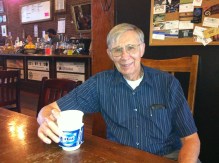
Cortes was born in Oakland in 1934, the son of a Mexican-American/Catholic father and German-American/Jewish mother, and grew up in Kansas City, Missouri before attending University of California, Berkeley and eventually taking his teaching position at UCR in 1968. He took time recently from his busy schedule to talk about his book while sipping coffee and munching at oatmeal cookies at Riverside’s iconic Back to the Grind coffee house.

“At my daughter Alana’s request, more than 10 years ago, I agreed to write the stories of our family history,” Cortes says. “I never set out to write or publish a book. In fact, the whole thing ended up being about 600 pages, in all,” he chuckles.” He began by writing short mini-biographies about each of his grandparents, and then his parents, and then about other family members, until he ended up with somewhere between 50-60 little anecdotes that focused on each person’s life and character. Much of the manuscript was penned while he sat at a table along the downtown Riverside promenade adjacent to the Mission Inn.

He quickly realized, once he began to review what he had written, that what he had originally considered to be personalized family stories, written for his daughter, just might appeal to other people. He relates an anecdote about how, when he was reading part of the manuscript aloud to Alana while seated at a former Bob’s Big Boy restaurant located at the corner of University and Iowa Avenues in Riverside, another customer poked his head out from another booth, and said “that’s a great story! You should publish a book!”

He realized that the heart of his story collection resonated strongly with a number of cultural and historical themes and nuances common to most, if not, all of us, including the search for identity and belonging that so many people in our richly diverse multicultural and religious diaspora that comprises our society struggle to reckon with. As the son of a mixed race/religion family, and keenly aware all his life of the tug-of-war he lived in between his parents and other family members, Cortes has struck, and poignantly elicited, something that many readers can easily identify with.

Initially, Cortes skimmed his manuscript for the key ideas that formed the core of a one-hour, one-person play that he wrote, based on these stories, and titled it A Conversation with Alana: One Boy’s Multicultural Rite of Passage. He has subsequently performed the play more than one hundred times around the country.

He later decided to edit and create a narrative structure to his larger manuscript and publish it as a book. With help from Malcolm Margolin, publisher of Heyday Books – who he reveals that he shared a long lunch with, with both of them telling little stories in Yiddish as they discussed ideas for the book -, and Heyday’s Acquisitions Editor, Gayle Wattawa, the much-abbreviated, final version of the current book began to take form. He also notes that, in creating the final manusucript for the book, he took the advice of author Elmore Leonard, who wrote the novel Get Shorty: “…leave out the parts that people skip.” It seems to have worked for Cortes’ book.

“It was important to me that I make my book accessible to as many readers as possible,” he Cortes says. “I was hoping to open up a general discussion, among readers, and at the readings I do, about issues of mixed racial and cultural backgrounds, which affects so many people everywhere in the melting pot of our society. I wanted to help articulate the experience, and find a common thread in this that others can relate to, so they don’t feel so isolated.”

The start of Rose Hill: An Intermarriage before Its Time begins, for example, by giving the reader a clear sense of this, at the start of Chapter 1: “Dad was a Mexican Catholic. Mom was a Kansas City-born Jew with Eastern European immigrant paragraphs. They fell in love in Berkeley, California, and got married in Kansas City, Missouri. That, alone, would not have been a big deal. But it happened to be 1933” (p.1).

The narrative arc of the book follows his parent’s controversial marriage and his own birth and growing-up years in Kansas City, and is told in short chapters, each of which serves as its own vignette, as a story in itself. Cortes reveals his parents’, and his own, struggles in their search for belonging to a society that all too often expects people, and family, to fit into neatly-prescribed and restrictive “norms.”

Although much of the book’s setting is placed in Kansas City, the book does have a definite Inland Empire-area flavor. Cortes talks, later in the book, about how he came to play an important role in the development of inter-cultural curriculum at UCR, as creator of the university’s Chicano Studies program in the 1970’s, which helped both him and his father reaffirm their Mexican-American heritage.

There’s also the passage in the book where Cortes and his wife discover his parent’s decades-old love letters, in storage in Cortes’ garage in Riverside. “Now, at the very time I was trying to reconstruct our family’s story, the letters had been revealed to me,” he writes. “And as I read them, I yet again rediscovered my family, as I had so many times before” (p. 160). The letters had somehow survived many moves across the country, and in fact, Cortes had almost mistakenly thrown them out while moving.

The overall impression of this gently-rendered, often humorous, sometimes heartbreaking, and honestly-written memoir is one that will remain with most readers, long after they’ve finished reading. Taken as a whole, the stories are highly readable, familiar, spirit warming and also, in a profound but never forceful manner, tinged consistently by the current of the book’s wider sense of vision and the compelling themes that it evokes.

In the past few months, Cortes has given readings from Rose Hill: An Intermarriage before Its Time throughout the Inland Empire, which he combines with a question and discussion forum with his audience. So far, he’s appeared at events sponsored by the Inlandia Institute, the Inland Empire Latino Artists, the Redlands Library, and at at UCR and at the annual Cesar E. Chavez breakfast in Riverside. He continues to give readings, and will soon be appearing at College of the Desert in Palm Desert and at a book festival scheduled at Barnes and Noble in Riverside this fall.

“It’s important to open up the dialogue on these issues,” Cortes says. “So far, all kinds of people have approached me to say that the book has given them a sense of understanding and familiarity with some of the bi-racial and bi-cultural and other issues of social duality that they struggle with.”

Rose Hill: An Intermarriage before Its Time may be purchased at the Heyday Books website or by contacting the Inlandia Institute.

—-

Ruth Nolan is a native of the Mojave Desert and a former California Desert District/Bureau of Land Management helicopter hotshot and engine crew firefighter. She is now Professor of English and creative writing at College of the Desert, and a California desert literature scholar. She is also a widely published poet/writer/photographer focused on writing and lecturing about California desert cultural and conservation issues, and is editor of No Place for a Puritan: the literature of California’s deserts, published by Heyday Books in 2009. She is a regular columnist contributing desert feature stories online for Heyday Books, and KCET Artbound, Los Angeles and has been a contributing writer to Desert Star Weekly Alternative. Nolan lives in Palm Desert blogs about life in the desert at http://ruthnolan.blogspot.com. She can be reached at runolan@aol.com

Deenaz P. Coachbuilder

Desert Rose

Hewn from the granite mountains,
each petal edged in frail white
carved across millennia, you were witness
to the graceful pronghorn as they made their way
through the Piute and San Jacinto mountains.
You mourn the shrinking grasslands,
scarce desert tortoise, forests of Joshua trees,
and sunshine amidst vast silent spaces,
the wild valleys of a vanishing frontier.
You long for a time devoid
of the footprint of mankind,
of telephone poles and fences.

The Last Bird

In the trees, along the lake,
countless water birds
breed in the winter months.
Snow-white egrets resting
beside soot-black cormorants,
the mighty open bill storks lived peaceably
next to the small white ibises,
the purple night herons.
          The common sparrows twittered,
          busily hunting for dry seed
          and nesting twig.

In the autumn, after the rains,
beyond the yellowing grass
gleams the rich dark green
of the lofty sal.
The fiery blossoms of the
flame of the forest disappear.
May-awe screams the peacock,
displaying its splendid feathers,
fanned out before adoring hens.
          Those forgotten sparrows bathed in the dust
          collected beneath overhanging branches.

Mumbai city attracted the screeching parrot
that scolded from the burnished brown
of the gulmohor tree.
Grey pigeons goodo-goed,
awkwardly encircling each other
along dusty ledges of rusted windows.
Crows held a caucus in the evening gloom.
          Sparrows drank off muddy water
          gathering along the dripping eaves.

Then the river waters rushing through
Manac’s spectacular gorge
                    dried.
Sanctuary grasslands that sheltered
the chukor partridge and the sarus crane
                    lay waste.
Leaves of the city’s gulmohors
                    cracked,
the garden guavas, house of the green totas
                    stripped, denuded.

And then the birds were gone.

Only the dull sparrows,
unnoticed amidst the dustbins
                    sang
               a last faint song.

A Scattering of Stars

Supposing that abruptly you learnt
how brief your life was to be, a year
left in this veil of reality,
what would you do?

A woman of consummate morality,
hers is a sunny life, rewards of work,
love of family, the warmth of friends.
She believes that men are intrinsically good.
She knows that for some there is a world
of darkness, but it has not touched her.
Disregarding prayer all her life,
she lives it quietly instead.

Her mind becomes a tumbled jumble
of unfulfilled desires and disbeliefs. What
if it were not true? Could she spend a week
amidst the tangled golden waters of Kerala?
Did she have time to read the holy Vandidads?
Whom should she tell? Seek out a habit of prayer?
Recount stored memories, to leave behind some mark?

She chooses the precious familiar,
a world reflected in her beloved’s smile,
the neighborhood evening walk,
and daily bread.

On an eternal orbit, her life span
is a tiny speck amidst a scattering of stars,
here, and then gone, her tracks slowly fading.

____

Deenaz P. Coachbuilder has been a resident of Riverside, California, since 1981. She received a Doctorate in Theater Arts from Brigham Young University, an M.S. in Communicative Disorders from Utah State, an M.A. and B.A from Bombay University, India. Deenaz is an educator, artist, poet and environmental advocate. She is a retired school principal, an adjunct professor in Special Education at California State University, San Bernardino, and a consulting Speech Pathologist. She is a Fulbright scholar, and the recipient of several awards, the most recent being President Obama’s 2011 “Volunteer Service Award.” She is a published poet in the U.S. and India, and is currently working on a publication of her poems.

Michael Dwayne Smith

The Breakfast Tree

New neighbor’s hanging over my fence, avocado face yammering about his bread and butter, bread and butter, Why don’t my boss understand this how I make my quota? My spring morning quiet, sitting under my orange and lemon trees in my lawn chair, has flown off with the flustered sparrows and towhees.

He’s only had the house a few months, after Pop Bartlett died, 91 years old. No idea where they stole in from. Not Oriental. Not Mexican. Brown skin, black haired, too many kids to count.

The man admires a fat orange on a branch of my tree that’s grown out too near the cinder block wall that divides us.

This whole valley was citrus farmers when I was a kid, I tell him. We sped our Schwinn bikes through dirt rows and around smudge pots, grabbing fruit, old men with rock salt in their shotguns chasing lamely behind. Lemon juice, orange juice, lime, it flowed to us free and fresh, like water from the aqueduct our grandfathers built. This was desert. They made a paradise from barren land. Before it was overrun, bankrupted by freeloaders.

I’m looking him dead in the eye.

There was people here, he says, gawking the near-to-burst fruit. They lived the land before missions come. They knew it. They had, you call, tribes. Indians to your cowboys, no? He laughs a little.

The last standing navel orange tree in the valley sits on my property. A plump, sweet, juice-spraying orange hangs in his sight, a breakfast promised by old California. He’ll pluck it as soon as I turn away. I could just snap it from the tree, white blossoms filling the air, and I could offer it, a prize for my late wife’s sake. She always took pity on these creatures.

But I do not. Will not. This is not humanity, it’s California. And I am not his bread and butter.

___

Michael Dwayne Smith proudly owns and operates one of the English-speaking world’s most unusual names.  Not counting a year in Alaska, he’s lived in or near the Inland Empire his entire life.  No one knows why.  He’s a long-ago graduate of U.C. Riverside’s undergrad creative writing program, where he studied with Stephen Minot, Maurya Simon, Susan Straight, and was honored to serve as editor-in-chief of UCR’s literary journal, Mosaic.  Michael’s poetry and fiction materialize at Monkeybicycle, BLIP (formerly Mississippi Review), Pirene’s Fountain, Right Hand Pointing, Northville Review, Red Fez, Quantum Poetry Magazine, Orion headless, Phantom Kangaroo, Four and Twenty, and other mysterious locations.  He lives in the high desert with his wife, son, and rescued animals—all of whom talk in their sleep.  He can be conjured using the spells michael dot blackbear at gmail dot com, michaeldwaynesmith.tumblr.com, or michaelthebear on Twitter.

Amy Floyd

           Amy Floyd has been a member of the Inlandia Creative Writing workshop in Riverside program since its first session began in June, 2008.

___

The Weaver of White Park

          There is a girl who greets the gates of White Park in Riverside every morning, as soon as the park opens for the day. With her bag on her arm, she waits for just the right spot. She walks the park on long, young legs. Her footsteps are light and unsure, unwilling to hurt the blades of grass she treads upon.

          Each day, she goes to a different spot. Today, she sits beneath a tree that stoops under its own age, and pats it gently on the trunk as one would pet a great beast. She nods a greeting to the others as they pass her. Some she has seen over the years, while others have come to look her over with keen eyes and curious minds.

          She takes the blanket from her bag and stretches it out upon the grass, still wet with dew. With patient hands, she pulls four wooden needles from her bag and listens for the time to begin. A man passes by, whistling a tune that only his ears can understand, and she snatches the notes with nimble fingers. They are silver with the light of joy and she measures each string from her ear to her heart. There are four strands in all to form the weft of her weave; four directions for the anchor of her creation. She threads the needles, polished smooth by time, and the four strands become eight. She nods her head to the foundation chain. Eight is a strong number, one that can last forever in the right hands.

          As the day passes, the woman lets her eyes wander over the city around her, her ears picking out the right pieces. A baby’s cry is lemon yellow and finds its way to her fingertips. She quickly feeds it onto the loom and snatches the burnt umber of an old man’s cough, adding it to the rose-colored coo of new lovers. The red and white of a paramedic’s siren are shadowed by the gray of deep loss. She works quickly to complement these new colors to her palate with the leafy green of new life carried in the womb of a woman passing by, a woman who knows not yet of the miracle within her. The electric blue of music pulses from the windows of passing cars. Next, the footsteps of a hurried pedestrian form a special shade of heather, soft and thick.

          The woman works quickly, the sun on the grass before her counting off the time of day. It used to be so much easier to work here, before the illusion of safety wrapped the park in shackles of iron.  There are so many sounds surrounding her, so many colors to choose from, and very little time in which to work. There’s a tangle of tan with office workers gossiping, not so much listening to the conversation, as each waiting for their turn to speak. This becomes framed by the orange of barking dogs and the scolding, red shouts of their owners.

          She strains her ears to find the golden notes, the ones without which no piece can be complete: the mumbled musings of an artist, reading poetry to inspire his or her next piece, some kind of universal truth that many search for their whole lives, only to find it waiting outside their front door. Today, she is presented with the gasp of a youth who has found that old age does not always grant wisdom, and that life is better lived firsthand. While books and songs may give the illusion of life, they pale in comparison to the experience itself.

          She smiles as she caresses the final piece, knowing, without looking, where it belongs. She shakes with the weight of it.  Her hands ache with the work. She slows, and the time draws near. She ties off the final strand to the edge of her piece and slips the thread from her needles. Now completed, the old woman lays the weaving before her to inspect her work. It is time for the park to close for the evening, and many pass before her out the gate. Some turn to look as they leave, nodding in approval. Others look with wonder. The last people walk by, their faces stone. The future will come to them as it always has; each day is a different piece.

          She takes one last glance at her finished work, knowing that it will dissolve with the next morning’s dew. She slips the needles into her bag and uses the tree’s trunk to pull herself up onto old, arthritic legs. Tomorrow is another day, and a new weaving. As the gates swing closed, she bids the park goodnight.
___

Amy Floyd, a resident of Riverside and mother of two young boys, holds a B.A. in Education from the University of Redlands. Her poetry and prose writing has been published in the 2011 Writing from Inlandia creative writing workshops anthology, and also in Slouching Toward Mt. Rubidoux Manor, issues #1-3 from 2008-10. Her writing has also appeared in Phantom Seed issue 4 in 2010. Amy  self published an e-book entitled Do Serial Killers Smile At Their Victims? through Amazon.com last April, and is currently in the process of publishing more electronic works. She is also an artist whose piece “Heading In” was published in 2011 in the anthology A Bird as Black as the Sun: California Poets on Crows and Ravens.

Yelizaveta Renfro

A writer and photographer, Yelizaveta P. Renfro’s work has appeared in Glimmer Train Stories, North American Review, Colorado Review, Alaska Quarterly Review, South Dakota Review, Witness, Reader’s Digest, Blue Mesa Review, and in newspapers. Her short story collection, A Catalogue of Everything in the World, is available from Black Lawrence Press. She lived in Riverside for more than twenty years and has since lived in Virginia, Nebraska, and Connecticut. View her work in this issue here & here.

Suzanne Maguire

Not Yet

spring, scratching at my skin and burning my eyes
the persistent chirping of a mockingbird
the sun too hot too early, on cold dry skin
long shadows on longer evenings

wild mustard and fescue
pushing through what has been carefully planted
exhaling hay fever
gnats, fruit flies, mosquitoes
sagging fruit trees
too full, too fast

cars whisk by leaving flashes of sound: rock music, mariachi, angry voices
there are new neighbors
unfamiliar voices filtering through the fence lined thick with xylosma
there are foxtails poking through my socks
but I am like the iris bulbs in the earth
waiting for their resurrection
not yet, not yet

___

Suzanne Maguire grew up running in the hills behind La Sierra University, playing hide and seek among the orange groves on Irving and Victoria Avenue, and racing her brother and sisters along the Gage canal. She took classes at Riverside Community College and received her bachelor’s degree in history from the University of California, Riverside. The more she writes the more she realizes that this city, or some fictional version of it, is not only the setting of her stories and poems, but a major character as well.

Suzanne Maguire

Suzanne Maguire grew up running in the hills behind La Sierra University, playing hide and seek among the orange groves on Irving and Victoria Avenue, and racing her brother and sisters along the Gage canal. She took classes at Riverside Community College and received ehr bachelor’s degree in history from the University of California, Riverside. The more she writes the more she realizes that this city, or some fictional version of it, is not only the setting of her stories and poems, but a major character as well. View her work in this issue here, here & here.

Matthew Nadelson

Barber Shop Poem, Riverside, California

I run my hand along the scars across the back
of my neck, and I’m fifteen again
in the barber’s chair,
his clippers hacking at my cysts.
He tells me barbers used to be doctors,
with their barbed brushes
and blunt scalpels, but I don’t buy it.
The ritual scalping over,
I glanced to my shoulders, sure the future
rested somewhere there in the red
blood trickling down,
buried beneath this husk
of flesh and bone. I shrugged it off,
fearing the future
was as inevitable as hair
or heat-bumps, as the barber called my cysts,
fruit of my teenage loneliness and fear,
the roots of desperation and despair.

Kate Anger

Self-Culture at the Arlington Branch Library, Riverside

An essay inspired by and subsequently delivered at the Inlandia reading celebrating the launch of its online journal at the Arlington Public Library, Riverside on July, 16, 2011.

“The only way to culture the working classes is to place books among them”
– Andrew Carnegie

           Between 1889 and 1923, industrialist and philanthropist Andrew Carnegie and his foundation funded 142 free public libraries in California (1,689 in total). If a community had the will, the land, and the commitment to public funding through taxes, the foundation would grant support. While this library is technically not a Carnegie library, the city was able to build it after obtaining a Carnegie grant for the expansion of the downtown library. With $7,500 in “extra” funding, the Greek revival structure was built, along with a firehouse attached to the back; it was the city’s first “branch” library.

           You are sitting in my childhood library. Not modern like its “boss” library downtown with the blue tile fountain you could walk around and floating stairs like on the Brady Bunch. The Arlington Branch was older, less fashionable, its milky-green, glass panes more serious—a dignified grandmother’s house. One entered on the side of the building, off Roosevelt Street, but even as a young child, it was clear to me the library had had another life before I started coming in the early 1970s. Peering into the “adult room”—now the community center where we gather today—I could see how the entrance had been on Magnolia Avenue, fronted by great columns; I could picture ladies in long, white dresses and men in bowler hats milling about and I felt connected to them. Sometimes I’d seek out the oldest books in the collection and hold them. I’d make myself as still as possible and close my eyes, my own version of psychometrics—the art of “communicating” with people via objects they’ve held. Maybe, just maybe, I’d get a glimpse of the library through their eyes. And in a way, of course, I did communicate with the dead in that library—authors long gone, their stories, hopes and heresies traveling on.

           I am a first generation Californian. We moved to Riverside in 1965 when my dad bought a pawnshop on Market Street (six months after downtown’s new central library was dedicated and a few years after the great, Mission-Revival Carnegie was torn down). I had no grandparents, no aunts, no uncles, and no cousins within 1,200 miles. I lived in a little box house that was less than 20 years old with furniture younger than that. No history, no tradition encumbered us. Studies show that kids without siblings—“only children”—bond more intensely with peers than do children that have siblings. I think this may be true of children without roots to place. Perhaps they bond more intensely to place than do people who have roots. Wanting to belong, I wrapped the town’s narrative into my own. At eight, I read The Queen’s Own Grove by Riverside author Patricia Beatty. Set in Riverside in 1881, it gave voice to what I’d been imaging all along. I adopted the heroine, Amelia Bromfield-Brown—a transplant like myself—as my ancestor and then creatively “cast” the Heritage House (a Queen-Anne style residence and city landmark, just one mile east on Magnolia) as Amelia’s home and my library as her own. (This connection with historic Riverside ran so deep that thirty years later I was still obsessed with founding families and orange groves and explored them my thesis play: Orange Grove.) So when I say this was my library, it was my library. I felt connected to those early twentieth-century library patrons because we shared the same space (and, as I got older, some of the same authors). They belonged here and so did I; I had the card and the card was all you needed.

           The Children’s Room is where we all start out if we’re lucky enough to have a parent who likes books—or even air conditioning (I make no judgments). We didn’t go to church (another thing that marked us as outsiders in Riverside in the 1960s-70s), but we entered the library with a kind of reverence. Beatrix Potter was my first high-priestess. Her tales of disobedience and punishment were nothing if not Old Testament, and the eventual welcoming back of the naughty kitten or disobedient bunny into the fold was a lesson in grace and forgiveness. I loved the way those books were perfectly sized for my little hands. I never tired of the mesmerizing, watercolor illustrations of little animals in coats drinking tea. I wanted to crawl inside and live there. Books can still make me feel that way. From this building, over and over, I checked out the Beatrix Potter books, as well as Clifford the Big Red Dog, Harold and the Purple Crayon, Where the Wild Things Are, Bread and Jam for Frances. Then I moved on to the Little House Books and the Encyclopedia Brown series, drawn to characters with pluck and grit—not to mention checking out every non-fiction book on horses (a cliché, I know).

           From a turn-of-the-century tract written by a group of New York state librarians: “The public library… shall forever stand as a monument of the homage paid by the people to self-culture.” Self-culture. Similar to one’s spiritual path, the library path was self-directed. Unlike with the school library, I wasn’t restricted to any one “age appropriate” section. I could wander at will. Go where my curiosity led, thanks in part to Carnegie, who was an advocate for “open stack” libraries where patrons were free to browse; in his time, many libraries were “closed stack,” requiring a librarian retrieve a requested book. At the library, they left you alone. Maybe this is why I don’t recall deep and abiding relationships with the librarians I must have encountered there. They were helpful when you needed them, but invisible and quiet when you didn’t. They didn’t care what you checked out. Bring it back (unmarked) was the only contract. They didn’t even check to see if you’d read it. It still brings me a certain “mission accomplished” satisfaction to return a stack of library books on time.

           At some point I moved—as we all do—away from the children’s room. In late elementary school I devoured tawdry, implausible tales by V.C. Andrews and Sidney Sheldon. And when my grandmother moved to California, I started reading the large print editions of the classics my mother checked out for her: Wuthering Heights, Pride and Prejudice, Jane Eyre in 18-point font. And non-fiction too: I can still remember the spot where all the Edgar Cayce books were kept: shelves of testimonials of near death experiences, encounters with the beyond—proof!—of life after death. Again, like church, the library held hope of eternal life.

           And no great cathedral is complete without art. At the Arlington Branch library in the 1970s, they didn’t just loan books and music, but art as well. We kept a spot reserved in our dining room for our monthly library “picture.” On “picture day,” we’d scour the back wall to see if our favorites were available: Renoir’s little girl; Seurat’s park; Waterhouse’s ladies-on-the-verge. Sometimes we’d have to settle for a moody Rembrandt or worse, a still life, but the space was always filled for us, a people inclined towards self-culture, a people sustained and lifted in this place with books among us. Thank you, Andrew Carnegie, and Patricia Beatty, and the unobtrusive librarians of my youth.

           Keeping with the library as church theme, I offer this benediction, a twist on the traditional Irish blessing:

May a chair rise up to meet you,
May a comfy pillow find your back,
May a good book fall into your hands,
And until we meet again, may we read, read, read and remember
enough of what we’ve read to have a halfway decent conversation.

~

Sources

Bulletin of the New York Public Library, Volume 24 By New York Public Library, p. 708

http://www.raincrosssquare.com/mt/2008/06/arlington_branch_library_reopens.php

http://www.carnegie-libraries.org/